
Every founder has a growth story they tell themselves. Fewer founders can actually answer six honest questions about what's really happening under the hood — and answering them honestly is usually the first real conversation we have with a business before it becomes a client. This is exactly the diagnostic a business growth partner in Pune exists to run, before recommending a single fix.
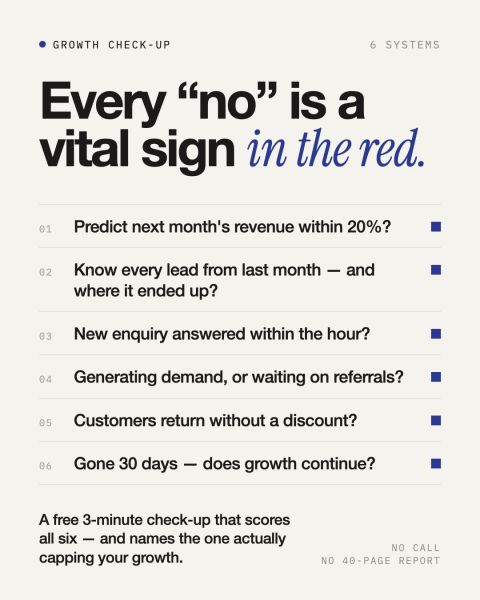
Can you predict next month's revenue within 20%? Do you know how many leads you got last month — and where each one ended up? Does a new enquiry get a response within an hour, or whenever someone remembers? Are you generating demand, or waiting for referrals? Do customers come back without a discount? If you disappeared for 30 days, would growth continue?
Every "no" is a vital sign in the red. Most businesses don't have one problem — they have one problem that's loudest, and several quieter ones sitting underneath it that never get addressed because the loud one keeps stealing all the attention.
Revenue Predictability Is the First Signal
If next month's revenue is a guess rather than a forecast, the business is being run reactively rather than systematically. This usually isn't a sales problem — it's a visibility problem, where deals, pipeline stages, and close probabilities live in someone's head instead of a system anyone can look at and trust. A growth partner's first job is often just making revenue visible before trying to grow it, which ties closely into how we approach B2B client engagement solutions more broadly — visibility into the relationship is what makes the revenue forecast trustworthy in the first place.
Knowing Where Every Lead Actually Went
Most businesses can say roughly how many leads came in last month. Far fewer can say where each one ended up — closed, lost, gone cold, still sitting untouched. That gap is where real revenue quietly disappears. Fixing it isn't about generating more leads through a lead generation strategy alone; it's about building a system that tracks every lead through to an actual outcome, which usually surfaces more recoverable revenue than any new campaign would.
Response Speed Decides More Deals Than People Realise
A new enquiry answered within the hour and one answered "whenever someone remembers" are, from the customer's side, two completely different companies. Slow response time doesn't just lose the deal in front of you — it trains prospects to expect mediocrity, which quietly erodes referral quality and word-of-mouth over time. This is one of the fastest, cheapest fixes a growth partner puts in place, because it requires process, not budget.
Generating Demand vs. Waiting on Referrals
Referrals feel like a compliment, but relying on them as a strategy is really just outsourcing growth to chance. A business that's actively generating demand — through content, outbound, or paid channels working together — controls its own growth rate. A business waiting on referrals is at the mercy of how many happy clients happen to mention you this month.
Discount-Free Retention Is a Trust Signal
If customers only come back when there's a discount attached, that's not loyalty — it's price sensitivity dressed up as retention. Genuine retention, where customers return because of the value and relationship rather than the deal, is one of the clearest signs a business has actually built something durable rather than something that only works while it's on sale.
The Founder-Dependency Test
The sixth question is often the hardest to answer honestly: if you disappeared for 30 days, would growth continue? For most founder-led businesses, the answer is no — not because the founder isn't good at their job, but because the business has never been asked to run without them. According to Harvard Business Review's research on founder-led companies, founder involvement can be a genuine advantage early on, but the same dependency that fuels early growth often becomes the ceiling that caps it later, unless the business is deliberately built to run without the founder in every decision.
Why This Needs a Partner, Not Just More Effort
None of these six problems get solved by working harder at whichever one feels loudest this week. They get solved by diagnosing all six honestly, then fixing them in the right order — which is precisely what a business growth partner in Pune is built to do, rather than treating growth as six unrelated fire drills.
As a growth consulting firm based in Baner, Pune, Grimbell built a free 3-minute check-up that scores all six of these signals properly and tells you which one is actually capping your growth — not the one that's loudest. No call required to see your results. No 40-page report. Just a straight diagnosis.
Ready to find out which of these six is actually holding your business back?
Talk to Grimbell about becoming your growth partner in Pune.
FAQs
What does a business growth partner actually do?
A growth partner diagnoses the specific bottlenecks holding a business back — revenue visibility, lead tracking, response speed, demand generation, retention, and founder-dependency — and fixes them in priority order, rather than applying generic marketing tactics.
How is a growth partner different from a marketing agency?
A marketing agency typically focuses on one channel, like ads or SEO. A growth partner looks at the whole system — sales, retention, and operations included — since growth is rarely capped by marketing alone.
How do I know which of the six signs is actually my biggest problem?
Most businesses assume it's whichever issue feels loudest that week, which is often not the real bottleneck. A proper diagnostic, rather than a guess, is the only reliable way to identify it.
Is this relevant for a business outside Pune?
The framework applies to any B2B business, though Grimbell works in person and remotely with businesses based in and around Pune specifically, given its base in Baner.
How does Grimbell's free check-up work?
It's a 3-minute assessment that scores all six growth signals and identifies which one is actually capping growth — no sales call required and no lengthy report, just a direct diagnosis.
