

Blog

  • B2B Lead Generation Services in India: What to Expect in the First 90 Days

    B2B Lead Generation Services in India: What to Expect in the First 90 Days

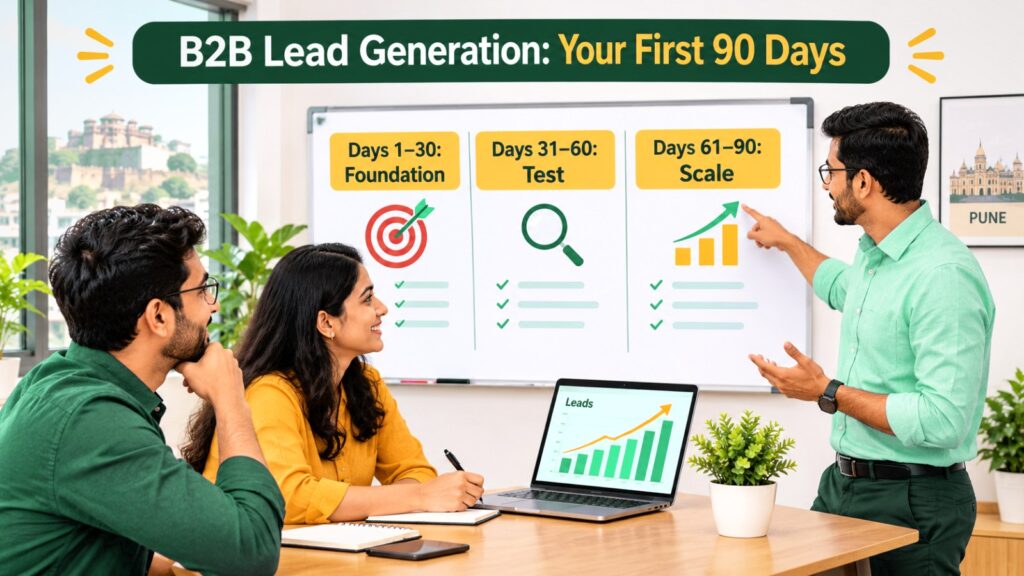
    If you are hiring B2B lead generation services in India, expect the first 90 days to move in three stages: 30 days of foundation work, 30 days of testing what brings enquiries, and 30 days of scaling what works. Real, sales-ready leads usually start building in the second month, not the first week. Knowing this timeline helps you judge an agency fairly and avoid pulling the plug just before results arrive.

    Most Indian manufacturers, distributors and service businesses we speak to have tried lead generation before. Many stopped after a few weeks because nothing seemed to happen. In almost every case, the problem was not the product or the sales team. As we often tell founders: it's not a quality problem. It's a visibility problem.

    Why the First 90 Days Matter So Much

    Lead generation is not a switch you turn on. It is a system that has to be built, tested and tuned for your market. A good agency spends the first quarter learning who your buyers are, where they search and what makes them reply. That learning is what turns random enquiries into a steady pipeline.

    When buyers cannot find you, or find an outdated website and an unmanaged Google profile, the enquiry goes to the competitor who simply showed up. The first 90 days are about fixing that, so your business shows up in the right places for the right buyers.

    Days 1 to 30: Building the Foundation

    The first month is mostly setup. It can feel slow, but it decides everything that follows.

    A serious agency will start by defining your ideal customer profile. Which industries buy from you, what size are they, who signs the purchase order and what problem makes them start looking? Without this clarity, campaigns reach the wrong people and you pay for leads your sales team cannot close.

    Next comes your digital presence. Buyers check you out before they reply, so your website, Google Business Profile and LinkedIn page need to look active and credible. Google itself notes that a complete and accurate Business Profile helps businesses show up in local search results, which matters if you sell to buyers in your city or region.

    The agency should also set up tracking in this period. Every form, call and WhatsApp enquiry needs to be recorded so you can see which channel produced which lead. Finally, they will prepare the first campaign assets: a clear offer, a short lead magnet such as a guide or checklist, and the first set of email, LinkedIn or ad messages.

    By day 30 you should expect a clear buyer profile, a cleaned-up online presence, working tracking and the first campaigns ready or just launched. You may see a handful of early enquiries, but volume is not the goal yet.

    Days 31 to 60: Testing What Works

    The second month is where B2B lead generation services in India start to show their real value. Campaigns go live across two or three channels, and the agency watches closely to see which messages and audiences respond.

    Expect to see different subject lines, offers and audience segments tested side by side. One message might get replies from plant heads but not from procurement managers. One channel might bring many enquiries that never convert, while another brings fewer but better ones. This is normal, and it is exactly what the testing phase is for.

    A good partner will report not just the number of leads but their quality. How many were genuine buyers? How many reached a meeting or a quote? Ask for this breakdown every week or fortnight. If your agency only talks about clicks and impressions, that is a warning sign.

    This is also the stage where your own team matters most. Leads need a fast, consistent follow-up. If enquiries sit unanswered for two days, even the best campaign will look like it failed. Agree on who responds, how quickly and what happens to each lead after the first call.

    If you want to understand how a strong agency structures this stage in more depth, our guide to choosing a lead generation agency in India explains what to look for before you sign.

    Days 61 to 90: Scaling the Channels That Deliver

    By the third month, the data should show clear winners. The agency's job now is to put more effort and budget behind the channels, messages and audiences that brought qualified leads, and to stop spending on the ones that did not.

    This is when lead volume usually starts to climb and the cost per qualified lead starts to fall. You should also see better conversations, because messaging has been refined for what buyers actually care about.

    Scaling is not only about more leads. It is about turning those leads into relationships. Buyers in B2B rarely purchase on the first conversation, so a nurturing process is essential: regular, useful follow-ups that keep your business in mind until they are ready to order. Strong B2B client engagement solutions make sure the leads you worked hard to win do not go cold.

    By day 90 you should have a predictable flow of qualified enquiries, a clear picture of your cost per lead and per meeting, and a plan for the next quarter.

    What Good Results Look Like After 90 Days

    Every industry and deal size is different, so be wary of any agency that promises a fixed number of leads before understanding your business. Instead, judge the first 90 days on progress you can see.

    By the end of the quarter, you should be able to answer a few simple questions. Do we know exactly who our best buyers are? Do we know which channel brings them? Are we getting more qualified meetings than before? Is the cost of each new customer reasonable for our margins? If the answers are mostly yes, your lead generation is working, even if the pipeline is still growing.

    Common Mistakes That Slow Down Results

    The most common mistake is stopping too early. Many businesses judge an agency on the first month, which is mostly setup. Give the system at least one full quarter before deciding.

    The second mistake is targeting everyone. A narrow, well-defined audience almost always performs better than a broad one, especially in B2B.

    The third is weak follow-up. Leads lose interest quickly. A slow or inconsistent response from your team can waste a good campaign.

    The fourth is ignoring your online presence. Even the best outreach fails if the buyer checks your website and finds nothing current. Showing up properly online is part of lead generation, not a separate task.

    Frequently Asked Questions

    How long do B2B lead generation services in India take to show results?

    Most businesses see early enquiries in the first month, but consistent, sales-ready leads usually build from the second month onwards. A full 90 days is a fair period to judge whether the approach is working.

    What should a lead generation agency do in the first month?

    The first month should cover your ideal customer profile, your website and Google Business Profile, lead tracking, and the first campaign messages and offers. It is foundation work that makes later results possible.

    How do I measure if my lead generation is working?

    Look beyond the number of leads. Track how many were genuine buyers, how many reached a meeting or quote, and your cost per qualified lead. These numbers matter more than clicks or impressions.

    Is lead generation suitable for manufacturers and distributors?

    Yes. Manufacturers, distributors and B2B service businesses often benefit the most, because their buyers research online before contacting suppliers. Being visible and credible at that stage brings more enquiries.

    Should I hire an agency or build an in-house team?

    It depends on your budget and how quickly you need results. An agency brings tested processes and tools from day one, while an in-house team takes longer to build but stays fully dedicated to your business. Many growing companies start with an agency and build internal capacity later.

    Make Your First 90 Days Count

    B2B lead generation is a system, not a shortcut. Give it a clear 90-day plan, judge it on quality rather than volume, and make sure your team follows up quickly. Do that, and the first quarter becomes the foundation for steady, predictable growth.

    If you would like help planning your first 90 days, Grimbell works with B2B businesses across India to build lead generation systems that bring real enquiries. Get in touch with our team in Pune to start the conversation.
  • B2B Client Engagement Solutions: Strengthen Client Relationships Around Diwali

    B2B Client Engagement Solutions: Strengthen Client Relationships Around Diwali

    The most effective B2B client engagement solutions around Diwali are simple: reach out personally before the festival, share one real result from the year, and book the review conversation for after the break. Diwali is the one time of year when clients expect to hear from you without a sales agenda, which makes it the best moment to strengthen the relationships that drive renewals and referrals. This guide shows Indian B2B firms how to plan engagement before, during and after Diwali, and how to keep the habits running all year.

    Why Diwali matters for client relationships

    Most B2B firms treat Diwali as a greeting-card exercise. A generic message goes out to the whole client list, a few gifts are sent, and the festival ends with nothing changed.

    That is a missed opportunity. Diwali sits at the point where many companies close the year's budgets, review vendors and plan the next twelve months. Clients are also more open to personal conversation than at almost any other time. A firm that uses this window well enters the new year with stronger accounts, clearer renewals and a few warm referrals. A firm that uses it badly is simply forgotten again by January.

    The difference is not budget. It is planning, and the plan has three phases.

    Phase one: before Diwali, know your accounts

    Engagement works when it is specific, and specific engagement starts with knowing where each client stands. Spend a few days on a simple account review.

    Sort your clients into three groups. The first is healthy accounts, where results are good and the relationship is warm. The second is growing accounts, where there is room to expand the work. The third is at-risk accounts, where replies have slowed, meetings are being skipped or complaints have gone quiet.

    For each client, note one thing: the most useful result you delivered this year, in a single sentence. This becomes the core of your message later. If you cannot name a result for a client, that is a signal in itself, and it should be fixed before you contact them.

    Then decide who owns each relationship. Every client needs one named person responsible for the message, the follow-up and the next step. Shared ownership usually means no ownership.

    Phase two: Diwali week, keep it personal

    This is where most firms get it wrong. A forwarded graphic or a mass email tells the client they are one name on a list.

    Write each message as a real person to a real person. Mention a project you worked on, a milestone they reached or a challenge you helped them through. Two or three sentences is enough. For example: "Wishing you and your team a happy Diwali. It was a pleasure working on the onboarding revamp this year, and I'm looking forward to what comes next."

    Keep the message free of any pitch. The moment a festive note carries a sales line, it stops being a gesture and starts being a tactic, and clients notice.

    If you send gifts, make them thoughtful and modest. A relevant, personal item shows attention. An expensive generic hamper shows budget. Avoid discount offers entirely. Heavy festive discounts train clients to wait for the next one and weaken the value of your work.

    For at-risk accounts, a personal call during the week can do more than any message. Ask how their year has been and listen. You are not trying to fix anything on the call. You are showing that you still care about the relationship.

    Phase three: after Diwali, hold the review conversation

    The festive goodwill is only useful if it leads somewhere. Within two weeks after the break, book a short review meeting with each key client.

    Use a simple structure. Start by sharing the result you noted in phase one, so the client sees the value you created. Next, ask what worked, what did not and what they want from the next year. Close by agreeing on one or two priorities and a date for the next check-in.

    This conversation does three things at once. It surfaces problems while they are still small. It reveals new work the client has not yet asked for. And it makes renewal feel like a natural continuation, not a negotiation.

    Write down what you learn and share it with your team the same week. Insight that stays in one person's head does not improve the relationship.

    Turn the festival into a year-round system

    A single festive push helps, but the firms with the strongest retention run engagement as a system. Structured B2B client engagement solutions give each account a regular rhythm that does not depend on anyone remembering.

    A good baseline looks like this:

    • a short check-in call every month for key accounts
    • a results summary every quarter, sent in a consistent format
    • a feedback request after every major milestone
    • a yearly review, which is the one you hold after Diwali

    Keep the rhythm light enough that the team will actually follow it. A simple shared tracker with the last contact date, the next step and the owner is often enough. If a client has not heard from you in two months, the tracker should show it.

    This also supports growth. Retained clients cost far less to serve than new ones, and a strong engagement rhythm creates the referrals that feed your pipeline. A lead generation agency in India can fill the top of your funnel, but the clients you already have remain the cheapest and most reliable source of new business.

    Mistakes to avoid

    Do not wait for a problem before reaching out. Clients who only hear from you when something goes wrong, or when a renewal is due, learn to associate you with friction.

    Do not make festive messages generic. If a client cannot tell that you wrote it for them, it adds nothing.

    Do not skip the follow-up. A warm Diwali note followed by silence until March wastes the goodwill you just built.

    Do not confuse activity with engagement. Sending more emails is not the goal. Understanding what each client needs and showing that you are delivering it is.

    How to know it is working

    Judge the effort by relationship health, not by messages sent. After the review round, you should be able to answer a few questions. How many key clients did you speak to? How many shared feedback? How many renewals are confirmed or in discussion? How many accounts have new work on the table? How many referrals or introductions did you receive?

    Compare the answers with last year. If the numbers are flat, look at the quality of the conversations before adding more activity. For a wider view of how B2B buyers evaluate vendors and where they spend their attention, the LinkedIn Marketing Solutions site is a useful starting point for planning content and outreach.

    Frequently asked questions

    What are B2B client engagement solutions?

    They are the processes and habits a business uses to stay in regular, useful contact with its clients, including check-ins, results reporting, feedback requests and review meetings. The aim is to build trust, catch problems early and keep clients renewing.

    When should B2B firms start Diwali client outreach?

    Begin the account review two to three weeks before the festival, send personal messages in the days around it, and book review meetings for the two weeks after the break.

    Should we send gifts to clients at Diwali?

    Gifts are optional. If you send them, keep them modest and personal. A thoughtful message matters more than the gift, and discounts are best avoided.

    How often should we contact key B2B clients?

    A short monthly check-in and a quarterly results summary work well for most firms, with a yearly review conversation. Adjust the rhythm to each client's size and preferences.

    How do we measure client engagement?

    Track the number of clients you spoke to, feedback received, renewals confirmed, new work discussed and referrals gained. Compare the figures with the previous year to see whether the relationships are improving.

    Build a stronger client engagement system with Grimbell

    Grimbell is a growth consulting firm in Pune that helps B2B businesses build client engagement and acquisition systems that last beyond a single campaign. If you want help planning your year-end client review or building a regular engagement rhythm, reach out to our team through the contact page on grimbell.com.

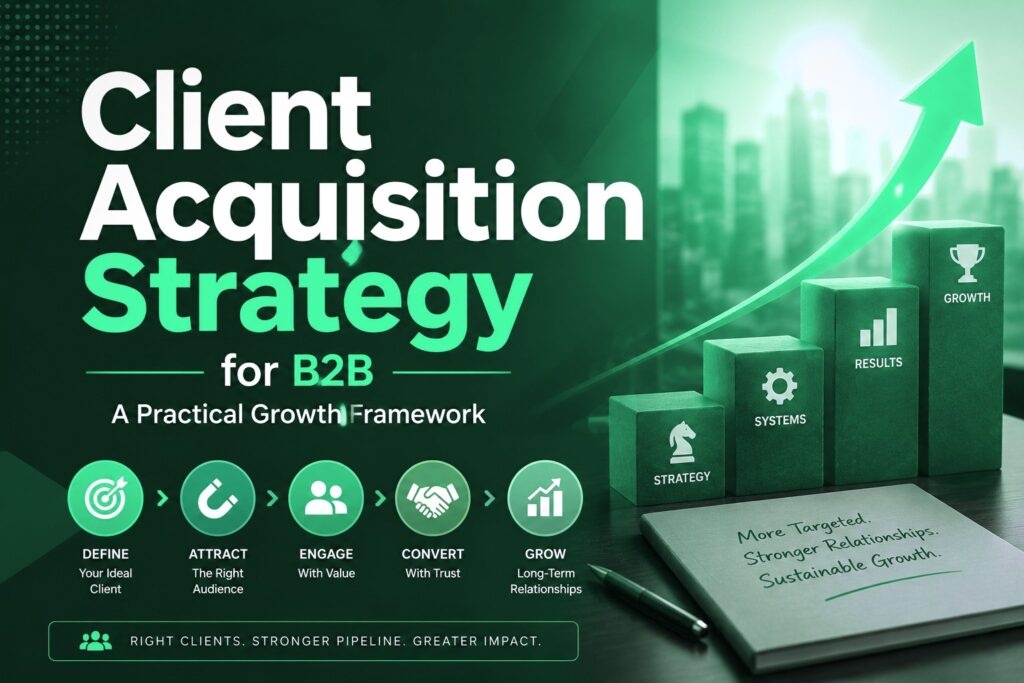
  • Client Acquisition Strategy for B2B: Get Clarity Before You SCALE

    Client Acquisition Strategy for B2B: Get Clarity Before You SCALE

    A B2B client acquisition strategy works only when buyers can instantly understand who you are, what you do and why you are different. If they cannot, more outreach, more ads and more content simply spread the confusion to more people. Before you scale in 2026, pause and ask the right questions. Growth doesn't fail because of lack of effort. It fails because of unclear positioning, inconsistent messaging, and weak brand recall. This guide explains how those three gaps drain your pipeline and how to close them before you spend more on acquisition.

    Why effort is rarely the problem

    Most B2B teams we speak to in Pune and across India are working hard. They send outreach every week, post on LinkedIn, run campaigns and chase referrals. Yet the pipeline stays thin and the conversion rate stays low.

    When effort is high and results are flat, the cause is usually upstream. The market is not ignoring the work. It simply cannot tell what you offer or why it should choose you over the next firm. Each message lands, but none of them builds on the one before.

    That is why the first step of any client acquisition strategy is not a new channel. It is a clear answer to a simple question: if a stranger reads your homepage or your first email for ten seconds, what will they remember?

    The three gaps that weaken acquisition

    Unclear positioning. If you describe yourself as a full-service partner for every kind of business, buyers cannot place you. A specific position, such as growth consulting for B2B service firms, gives them a reason to reply and a reason to refer you.

    Inconsistent messaging. Your website says one thing, your LinkedIn page says another, and your sales deck says a third. Prospects who see you in more than one place feel the mismatch even if they cannot name it. Trust drops, and so does the reply rate.

    Weak brand recall. B2B buying cycles are long. A prospect may see your name today and need you six months from now. If nothing about you is memorable, they will search for a firm they remember, and it will not be yours.

    Each gap raises the cost of every lead you pay for. Fixing them lowers it without adding a single new activity.

    What a strong brand should do for acquisition

    A strong brand should clearly communicate its value, stand out in a crowded market, build trust, not just attention, and support real business and growth goals. Each of these maps directly to a stage of your acquisition process.

    Clear value shortens the first conversation. When a prospect understands your offer in one line, you spend the call on their situation instead of on explanations.

    Standing out earns the click and the reply. In a crowded inbox, a specific message about a specific problem beats a polished but generic one.

    Trust moves a prospect from interested to ready. Attention gets a visit to your site, but proof, consistency and a clear point of view are what get a proposal signed.

    Support for real goals keeps the work honest. If a brand activity cannot be tied to pipeline, retention or revenue, it is a cost, not a strategy.

    A simple clarity check before you scale

    Run these four checks before you increase your outreach volume or ad spend.

    Ask five people outside your company to read your homepage for ten seconds and describe what you do. If their answers differ from yours, your positioning needs work.

    Compare your website headline, LinkedIn tagline and email signature. They should say the same thing in slightly different words.

    Look at your last twenty outreach messages. If they could be sent by any competitor with only the name changed, they are not differentiated.

    Review your last five lost deals. If the reasons include "we were not sure what made you different," the gap is clarity, not price.

    If any of these checks fail, fix them first. It takes days, not months, and it improves the result of everything you do afterwards.

    How clarity makes every channel work harder

    Once the message is sharp, each acquisition channel improves without any change in spend.

    Outbound gets higher reply rates because the first line speaks to a defined buyer. Content earns more shares and saves because it carries a recognisable point of view. Referrals increase because your clients can explain what you do in one sentence. Paid campaigns convert better because the landing page matches the promise in the ad.

    This is also what makes outsourced support effective. A lead generation agency in India can only generate the right leads if your positioning is clear enough to brief them on. Weak positioning gives the agency a vague target, and the leads that come back reflect it.

    The same applies after the first call. Once a prospect becomes a client, consistent B2B client engagement solutions keep the promise you made in the sales process, which turns satisfied clients into the referral engine that lowers your acquisition cost over time.

    Where the scaling mistake usually happens

    The common mistake is to treat scale as the solution to a weak pipeline. A firm hires two more salespeople, doubles its outreach and increases its ad budget, and the same low conversion rate now applies to twice the volume. If your audience can't instantly understand who you are, what you do, and why you're different, scaling will only amplify the gaps.

    Scaling is a multiplier. It makes a clear offer grow faster and makes an unclear one fail faster. Decide which you are multiplying.

    For research on how brand and clarity influence B2B buying decisions, the LinkedIn B2B Institute publishes useful studies that you can use alongside your own data.

    Refine, strengthen, then grow

    Once the clarity check is complete, the work becomes straightforward. Refine the message so it is specific. Strengthen the places where buyers meet you, including your site, profile and proposals. Then grow the channels that bring the right people in. In that order, every rupee and every hour spent on acquisition goes further.

    Frequently asked questions

    What is a client acquisition strategy for B2B?

    It is a structured plan for finding, reaching and winning business clients. It combines positioning, messaging, channels and follow-up so that each stage supports the next.

    Why does brand clarity matter for client acquisition?

    Buyers act on offers they understand. Clear positioning raises reply rates, shortens sales calls and makes referrals easier, which lowers the cost of every new client.

    How do I know if my positioning is unclear?

    Ask outsiders to describe your business after a ten-second look at your website. If their descriptions differ from yours or from each other, the positioning is unclear.

    Should I fix my messaging before hiring a lead generation agency?

    Yes. An agency can only target the right buyers if your offer is specific. Clear messaging gives them a sharper brief and improves lead quality from the first month.

    How long does it take to see results after fixing clarity?

    Message and website changes can be made within a few weeks. Improved reply rates and conversations usually appear in the following one to two months, depending on your sales cycle.

    Build a clearer acquisition engine with Grimbell

    Grimbell is a growth consulting firm in Pune that helps B2B businesses sharpen their positioning, align their messaging and build a client acquisition strategy that scales. If you want a clarity review before you invest further in growth, get in touch with our team.

  • Lead Generation Agency in India vs. In-House Team: What Actually Costs More

    Lead Generation Agency in India vs. In-House Team: What Actually Costs More

    At some point, most growing B2B founders ask the same question: would it be cheaper to just hire someone in-house instead of paying a lead generation agency in India? On paper, a single salary often looks smaller than a monthly retainer. In practice, the comparison is rarely that simple, and getting it wrong tends to be an expensive mistake either way.

    Here's the actual math most founders skip when they run this comparison in their head.

    The Salary Number Everyone Starts With

    A mid-level lead generation or SDR hire in India typically costs somewhere between ₹4-8 lakh annually, depending on experience and location. Compared to a retainer that might sit in a similar range, the in-house option often looks like the obvious choice at first glance. But a salary is only the starting line item, not the full cost of building this function internally.

    The Tools Stack Nobody Budgets For

    A single hire doesn't come with an outbound system already built. Running proper lead generation requires a CRM, an email sequencing tool, a data/enrichment provider for contact information, and often a LinkedIn automation or outreach tool — easily adding ₹15,000-40,000 per month in software costs alone, on top of the salary. An agency typically has this stack already built, tested, and amortized across multiple clients, which is one of the quieter cost advantages that rarely shows up in a simple salary comparison.

    The Ramp-Up Time That Delays Everything

    A new in-house hire, even an experienced one, needs time to learn the specific ICP, message-test what actually resonates, and build a working cadence — typically 6-10 weeks before consistent results start showing up. During this entire period, the business is paying full salary for a system that isn't yet producing pipeline. A lead generation agency in India that's already built comparable systems for other clients usually starts producing measurable activity within the first two to three weeks, simply because the infrastructure and testing process already exist.

    The Management Overhead That's Easy to Underestimate

    An in-house hire needs management — someone reviewing their outreach quality, tracking their numbers, coaching their messaging, and holding them accountable to targets. For a founder or a small leadership team already stretched thin, this is real time that doesn't show up on a balance sheet but absolutely shows up in what else doesn't get done that week. An agency relationship, by contrast, typically requires a fraction of that oversight, since the quality control and process management happen on the agency's side.

    The Single-Point-of-Failure Problem

    When lead generation depends on one in-house person, their vacation, their illness, or their eventual resignation creates a real gap in pipeline generation — and rebuilding that knowledge with a replacement hire means resetting the ramp-up clock all over again. This is closely tied to the same fragility we see in founder-dependent businesses more broadly — concentrating a critical growth function in a single person creates risk that's invisible until the moment it actually matters. It's part of why most businesses eventually work with a dedicated lead generation agency in India rather than betting the entire function on one internal hire.

    Where In-House Genuinely Wins

    None of this means an agency is always the right answer. Once a business reaches sufficient scale — typically supporting two or more dedicated reps worth of consistent pipeline need — building an internal team can become genuinely more cost-effective, because the fixed costs (tools, systems, management) get spread across more output. In-house also wins when deep, ongoing product knowledge is essential to effective outreach, since an internal hire accumulates that context in a way an external partner has to work harder to replicate.

    The Real Comparison Isn't Salary vs. Retainer

    The honest comparison isn't the monthly number on an invoice versus a payslip — it's total cost of a working, producing system versus total cost of building and maintaining that same system internally, including the tools, the ramp-up period, the management time, and the risk of depending on a single person. According to Gartner's research on B2B buying behavior, most B2B buyers now expect a highly researched, consistent outreach experience — which itself requires the kind of tested messaging and systematic process that takes real time and iteration to build, whether that iteration happens inside the company or through a partner who's already done it elsewhere.

    A Practical Way to Decide

    A reasonable way to make this decision: if the business needs pipeline running within the next month and doesn't already have outbound infrastructure built, a lead generation agency in India gets there faster with less upfront cost and risk. If the business has 3-6 months of runway to build patiently, already has some internal marketing infrastructure, and expects to need multiple dedicated reps within a year, building in-house from the start may make more sense.

    Many businesses actually end up doing both in sequence — starting with an agency to prove out the channels and messaging that work, then eventually bringing an in-house team on to scale what's already been validated, rather than building blind from day one.

    How Grimbell Approaches This With Clients

    At Grimbell, based in Pune, we're upfront with prospective clients about this exact tradeoff — because the right answer genuinely depends on the business's stage, runway, and existing infrastructure, not on which option happens to generate more revenue for us. Our engagements are built around getting a working, measured pipeline running fast, with a clear path to internal scaling once the volume justifies it.

    Not sure which side of this decision your business is on?

    Talk to Grimbell about what makes sense for where you actually are right now.

    FAQs

    Is a lead generation agency in India cheaper than hiring in-house?
    It depends on the full comparison, not just salary versus retainer. When tools, ramp-up time, and management overhead are included, an agency is often cheaper for businesses that don't yet have outbound infrastructure built, while in-house can become more cost-effective at larger scale.

    How long does it take to see results from an agency versus an in-house hire?
    An agency with existing systems typically produces measurable activity within 2-3 weeks. An in-house hire, even an experienced one, usually needs 6-10 weeks to build a working cadence and start showing consistent results.

    Can a business switch from an agency to an in-house team later?
    Yes, and many do — starting with an agency to validate which channels and messaging actually work, then building an internal team once the volume justifies dedicated headcount, rather than building blind from scratch.

    What tools does an in-house lead generation hire actually need?
    At minimum, a CRM, an email sequencing tool, a contact data/enrichment provider, and often a LinkedIn outreach tool — typically adding ₹15,000-40,000 per month in software costs on top of salary.

    Does Grimbell only recommend agency work, or does it help with in-house transitions too?
    Grimbell advises based on the client's actual stage and needs, including helping businesses eventually build and hand off to an internal team once their pipeline volume justifies it.

  • Brand Clarity for B2B Businesses: Why Talent Isn’t Your Growth Problem

    Brand Clarity for B2B Businesses: Why Talent Isn’t Your Growth Problem

    Most businesses don't struggle because of lack of talent — they struggle because of lack of clarity. This is the pattern we see constantly working with B2B companies, and it's exactly why brand clarity for B2B businesses matters more than almost any other growth lever available to a founder right now.

    The team is capable. The service or product genuinely works. And yet growth stalls, deals take longer than they should, and the business feels stuck competing on factors that were never supposed to matter this much. The problem usually isn't ability — it's that the business hasn't clearly defined what it is, who it's for, and why it's different.

    Before Strong Branding: The Familiar Pattern

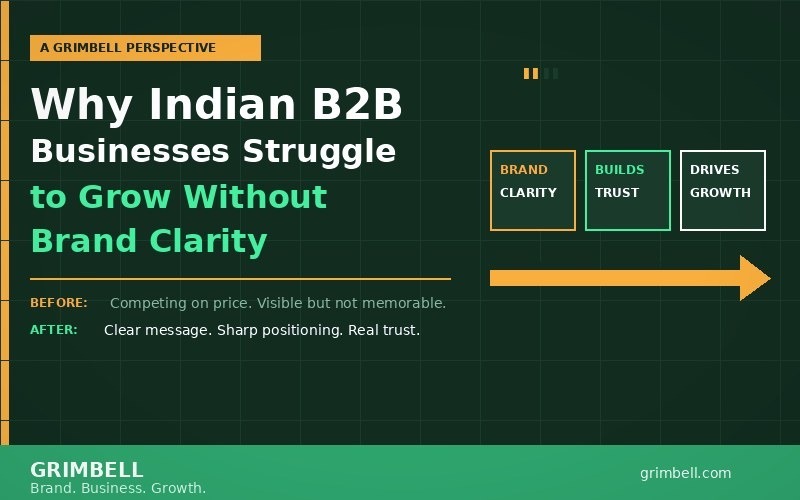
    Businesses without brand clarity tend to share three specific traits. First, they do everything — trying to serve every possible client rather than owning a specific position in the market. Second, they end up competing on price, because without a clear differentiator, price is the only lever left to pull. Third, they're visible but not memorable — someone might see the company's name, but nothing about it sticks.

    Each of these traits reinforces the others. Doing everything for everyone makes pricing competition inevitable, because there's no premium position to defend. And being visible without being memorable means marketing spend generates impressions without generating recall — the exact opposite of what marketing is supposed to accomplish.

    After Strong Branding: What Actually Changes

    On the other side of brand clarity, three things replace those patterns. A clear message means prospects immediately understand what the business does and why it matters, without needing it explained twice. Sharp positioning means the business owns a specific space in the buyer's mind, rather than blending into a category of interchangeable options. And value-driven confidence means pricing conversations stop being about matching a competitor's rate and start being about the value being delivered.

    This shift isn't cosmetic. It changes how deals get won, how long sales cycles take, and how much a business can charge without losing the deal to a cheaper alternative.

    The Result Isn't Just Visibility — It's Credibility

    This is the core distinction that gets missed when businesses think about branding purely as a design exercise. Visibility means people have seen the name. Credibility means people trust what the name stands for before they've even had a conversation. The same logic applies to leads versus trust — a business can generate plenty of leads through outbound volume or paid spend, but leads without trust convert poorly and take far longer to close than leads that arrive already believing the business is credible.

    This is closely tied to how we think about B2B client engagement solutions more broadly — the same clarity that makes a brand memorable is what makes an engaged prospect actually trust the relationship enough to convert. Engagement without a clear underlying brand message tends to feel transactional; engagement built on genuine clarity feels like the natural next step in a relationship the prospect already trusts.

    Why Founders Often Can't See This From the Inside

    One of the more counterintuitive parts of brand clarity work is that founders are often the worst-positioned people in the company to diagnose it. When you've lived inside the business for years, the positioning feels obvious to you — of course people understand what makes this company different, because you've never had to explain it any other way. The scattered feeling a prospect experiences on first contact is often invisible to the person who built the business, precisely because they never see it with fresh eyes.

    According to Forbes' research on brand clarity, businesses with clearly articulated positioning consistently outperform competitors with stronger products but weaker messaging — because buyers cannot choose what they do not understand.

    What Brand Clarity Work Actually Involves

    Brand clarity is not a rebrand. It rarely starts with a logo or a colour palette. It starts with three questions the business has to answer in a single sentence each: what do we do, who is it for, and why us rather than the alternative. Most businesses can answer these in a paragraph. Very few can answer them in a sentence, and that gap is precisely the problem a prospect experiences on first contact.

    The work that follows is mostly subtraction. Cutting the services that dilute the position. Removing the qualifiers that hedge the message. Choosing the one audience the business is genuinely best placed to serve, and accepting the ones it will stop competing for. This is why founders often resist it — clarity always costs something on the way in, and only pays back once the market starts recognising the business for a specific thing.

    How Grimbell Approaches Brand Clarity

    As a B2B growth consulting firm based in Pune, we treat brand clarity as the foundation the rest of the growth work sits on, not a separate exercise. Positioning gets defined before campaigns get built, because outreach that carries an unclear message simply spreads the confusion more efficiently. Our business growth partner engagements typically begin here for exactly that reason.

    Not sure whether clarity is what's actually holding growth back? Talk to Grimbell about where your positioning currently stands.

    FAQs

    Is brand clarity the same as rebranding?
    No. Rebranding changes how a business looks. Brand clarity changes what it says and who it says it to. A business can gain complete clarity without changing a single visual element.

    How do I know if my business has a clarity problem?
    A reliable test: ask three people in your company to describe what the business does in one sentence. If the answers differ meaningfully, prospects are hearing the same inconsistency.

    How long does brand clarity work take?
    The definitional work usually takes a few weeks. Rolling it through the website, sales material and outreach takes longer, since every touchpoint has to say the same thing.

    Will narrowing our positioning lose us business?
    In the short term it may remove some poor-fit enquiries. In practice those enquiries were converting badly and competing on price anyway. Sharper positioning trades volume for conversion rate.

    Does brand clarity help with lead generation?
    Directly. Outbound and paid campaigns both perform better when the message landing on the prospect is specific. Clarity is what makes the same spend produce better results.

  • How a Lead Generation Agency in India Builds a B2B Sales Pipeline From Scratch

    How a Lead Generation Agency in India Builds a B2B Sales Pipeline From Scratch

    Most founders assume hiring a lead generation agency in India means outsourcing a stack of cold emails and hoping something sticks. In practice, a proper engagement looks nothing like that — it's a structured build process, closer to constructing a piece of infrastructure than running a campaign. Here's what actually happens, step by step, when Grimbell builds a B2B pipeline from scratch for a client.

    Step 1: Defining the Ideal Client Profile First

    Before a single email goes out or a single ad gets built, the work starts with defining exactly who the business should be targeting. This goes well beyond "companies with 50-200 employees" — it means identifying the specific industry, the trigger event that makes a company ready to buy, and who inside that company actually feels the pain versus who signs off on the budget. Skipping this step is the single most common reason lead generation efforts fail before they even start; without a sharp ICP, every channel downstream ends up targeting the wrong audience with the right message, or the right audience with the wrong one.

    Step 2: Auditing What's Already Working (and What Isn't)

    Very few businesses start from absolute zero. Most have some combination of past outreach, an existing website, a handful of referral relationships, and maybe a dormant LinkedIn presence. Before building anything new, the audit stage looks honestly at what's already generating interest, what's generating noise, and what's simply been abandoned. This prevents the common mistake of rebuilding a channel from scratch that was actually working fine, just unmeasured.

    Step 3: Choosing Channels Based on Where the ICP Actually Spends Time

    Channel selection isn't about picking whatever's trendy — it's about matching where the defined ICP actually makes buying decisions. A B2B software buyer researching quietly on LinkedIn behaves very differently from a manufacturing procurement lead who still responds best to a direct phone call. A lead generation agency in India typically builds a mix of two or three channels working together — often outbound email, LinkedIn outreach, and targeted content — rather than betting everything on a single channel that may not fit how this specific buyer actually operates.

    Step 4: Building the Outbound System, Not Just a List

    This is where the actual infrastructure gets built. A list of 500 contacts means very little without a system behind it — sequenced messaging, personalization at scale, a cadence that doesn't burn out the list in week one, and a process for handling replies (interested, not now, wrong contact) that keeps the pipeline clean rather than cluttered. This system is designed to run continuously, refined weekly based on actual reply rates, rather than treated as a one-time campaign with a start and end date.

    Step 5: Building Supporting Content That Pre-Sells

    Outbound rarely works in isolation. By the time a prospect responds to a cold email or LinkedIn message, they usually check the company's website, LinkedIn page, or a shared case study before agreeing to a call. This is where B2B client engagement solutions content plays a direct role in lead generation itself — case studies, comparison pages, and specific proof points do the work of building credibility before a rep ever gets on a call, which meaningfully increases show-up and conversion rates for the outbound system running in parallel.

    Step 6: Setting Clean Qualification Criteria

    Not every reply to an outbound message is a qualified lead. A structured pipeline defines clear qualification criteria upfront — budget range, decision-making authority, timeline, and genuine fit with the ICP — so the sales team isn't wasting time chasing conversations that were never going to close. This step alone often surfaces that a business was previously counting "leads" that were really just polite responses with no real buying intent behind them.

    Step 7: Building the Handoff to Sales Properly

    A lead generation system that produces qualified conversations is only half the job if the handoff to sales is informal or inconsistent. This stage defines exactly how a lead moves from marketing-qualified to sales-ready, who owns follow-up, and what response-time expectations look like. Without this, even a well-built lead generation engine leaks revenue at the exact moment it should be converting.

    Step 8: Measuring and Refining, Not Set-and-Forget

    Once the pipeline is running, the work shifts to measurement — response rates by channel, conversion rate at each stage, and cost per qualified lead by source. This data is what separates a lead generation agency in India from an internal team running outreach without structured tracking: the system gets refined weekly based on what the numbers actually show, not on assumptions about what should be working.

    Why This Takes a Dedicated Partner, Not a Side Project

    Building all eight of these stages properly — ICP definition, channel selection, outbound systems, supporting content, qualification, sales handoff, and ongoing measurement — is a full discipline in itself, distinct from running the core business. According to McKinsey's research on B2B growth, companies that build structured, systematic go-to-market processes consistently outperform those relying on ad-hoc effort, largely because a proper system compounds in ways reactive outreach never does.

    This is precisely why most growing B2B companies eventually bring in a dedicated lead generation agency in India rather than trying to build this infrastructure internally alongside everything else running the business day to day.

    Building This With Grimbell

    As a B2B growth consulting firm based in Pune, Grimbell builds exactly this eight-stage pipeline for clients across India — from initial ICP definition through to a measured, continuously refined outbound system with a clean handoff to sales. It's built once, properly, rather than patched together channel by channel as urgency demands.

    Ready to see what a properly built B2B pipeline actually looks like for your business?

    Talk to Grimbell about building a lead generation system from the ground up.

    FAQs

    How long does it take to build a B2B lead generation pipeline from scratch?
    Most engagements take 4 to 6 weeks to move from ICP definition through to a fully running, measured outbound system, though timelines vary based on how much existing infrastructure (website, past outreach, content) is already in place.

    What's the difference between a lead list and a lead generation system?
    A list is just contact data. A system includes sequenced messaging, qualification criteria, a defined handoff to sales, and ongoing measurement — the infrastructure that turns a list into actual pipeline revenue.

    Do I need a large budget to start a lead generation service?
    Not necessarily. The most important early investment is time spent on ICP definition and channel selection, since getting that right determines whether any subsequent spend on outreach or content actually converts.

    Can this work alongside our existing referral-based growth?
    Yes — a structured lead generation system typically runs alongside referrals rather than replacing them, giving the business a growth channel it can actually influence and scale independently of referral timing.

    How is this different from the general lead generation services Grimbell already offers?
    This describes the specific build process — the eight stages a lead generation agency in India actually works through — behind Grimbell's broader lead generation service for B2B companies.

  • 5 Signs You Need a Lead Generation Agency in India

    5 Signs You Need a Lead Generation Agency in India

    Working hard ≠ moving forward. That's the uncomfortable truth behind a specific kind of stuck we see constantly in growing B2B companies — and it's usually the moment a business realizes it needs a proper lead generation agency in India, not just more hustle from the founder.

    If your business doesn't feel stuck, it's probably because you're not working in the business instead of on it. Here are five signs it may be time to rethink how you're operating.

    Sign 1: You're Doing Everything Yourself

    When a founder is personally involved in every deal, every client conversation, and every piece of outreach, growth has a hard ceiling — the founder's own available hours. This isn't a discipline problem; it's a structural one. Businesses that break past this stage have usually handed lead generation to a system (or a partner) that keeps producing qualified conversations without the founder personally chasing each one down.

    Sign 2: Decisions Are Driven by Guesswork Instead of Data

    Without visibility into where leads actually come from, which channels convert, and which ones just generate noise, every marketing decision becomes a guess dressed up as strategy. A dedicated lead generation agency in India typically starts by fixing exactly this — building the tracking and attribution that turns "I think LinkedIn is working" into an actual, defensible number.

    Sign 3: Your Brand Blends In Instead of Standing Out

    If a prospect can't immediately tell you apart from three competitors after glancing at your website, that's not a branding footnote — it's a lead generation problem. Generic positioning generates generic interest, and generic interest converts poorly no matter how much budget sits behind it. This is closely tied to how we think about B2B client engagement solutions more broadly — the same clarity that makes a brand memorable is what makes an engaged prospect actually convert into a client.

    Sign 4: Client Acquisition Depends Mostly on Referrals

    Referrals feel great, but they're not a strategy — they're a symptom of not having one. A business that only grows when a happy client happens to mention it to someone is, in effect, outsourcing its growth rate to chance. A proper lead generation agency in India builds systems — outbound, content, and paid channels working together — so growth doesn't depend on which clients happen to be in a talkative mood this quarter.

    Sign 5: Every Day Is Packed, But Progress Feels Slow

    This is perhaps the clearest sign of all: a calendar that's genuinely full, paired with a business that doesn't feel like it's actually advancing. Being busy and being productive toward growth are not the same thing, and it's entirely possible to spend an entire year in constant motion while the fundamentals — pipeline, positioning, demand — stay exactly where they started.

    The Solution Isn't Always More Effort

    It's tempting to respond to a stuck feeling by simply working harder, staying later, pushing through. But if the previous year of hard work hasn't moved the needle, another year of the same hard work is unlikely to either. Sometimes it's better strategy, stronger systems, and the right partner — not more hours from an already-stretched founder.

    Why This Requires a Dedicated Partner, Not Internal Effort Alone

    Founders are naturally good at building the product or service that made the business worth starting in the first place. That skill set doesn't automatically transfer to building a repeatable demand-generation engine — and trying to do both well, at the same time, with the same limited hours, is exactly how businesses end up stuck despite genuine effort.

    According to Forrester's research on B2B lead generation, companies with dedicated, structured lead generation processes consistently outperform those relying on ad-hoc or founder-driven outreach, largely because structured processes compound over time in a way that reactive effort simply can't.

    What a Lead Generation Agency in India Actually Fixes

    A dedicated lead generation agency in India doesn't just add more outreach volume on top of what a founder is already doing manually. It replaces guesswork with tracked, measurable channels; replaces referral-dependency with a repeatable demand engine; and replaces founder-driven urgency with a system that keeps generating qualified conversations whether or not the founder personally has bandwidth that week.

    This is precisely the diagnostic Grimbell runs with growth-stage businesses before recommending anything — because the fix for "client acquisition depends mostly on referrals" is rarely more referrals. It's a proper lead generation system that doesn't rely on chance.

    Working With Grimbell

    At Grimbell, based in Baner, Pune, we work with B2B companies across India who recognize themselves in some (or all) of these five signs. We build the lead generation systems, tracking, and positioning clarity that let growth continue whether or not the founder is personally driving every conversation.

    What's the biggest challenge holding your business back right now? If it's one of these five signs, the fix usually isn't more effort — it's the right system and the right partner.

    Ready to move from busy to scalable?

    Talk to Grimbell about building a lead generation system for your business.

    FAQs

    How do I know if I actually need a lead generation agency?
    If client acquisition depends mostly on referrals, decisions are made without real data, or you're personally involved in every deal, these are strong signs that a structured lead generation system — rather than more individual effort — is the missing piece.

    What does a lead generation agency in India actually do differently from in-house effort?
    A dedicated agency builds tracked, repeatable channels (outbound, content, and paid working together) instead of ad-hoc outreach, and brings the attribution data needed to know which channels are actually working.

    Is referral-based growth really a problem if referrals are strong?
    Referrals are valuable, but relying on them as a primary strategy means growth is dependent on factors outside your control. A lead generation system complements referrals rather than replacing them, giving the business a growth rate it can actually influence.

    How long does it take to see results from a lead generation system?
    Most B2B companies start seeing measurable pipeline activity within 8 to 12 weeks, though results depend on industry, deal size, and how much tracking infrastructure already exists.

    Does Grimbell work with businesses outside India?
    Grimbell is based in Baner, Pune, and primarily works with B2B companies across India, though remote engagements are handled case by case.

  • Sales Growth Consulting in Baner, Pune: A Local Growth Framework

    Sales Growth Consulting in Baner, Pune: A Local Growth Framework

    Most B2B businesses in Baner and across Pune don't have a sales team problem — they have a sales system problem. The reps are working, calls are happening, proposals go out. But revenue still feels unpredictable, and nobody can say with confidence why one month closes strong and the next one doesn't. This is exactly the gap that sales growth consulting in Baner, Pune is built to close — not by adding more activity, but by fixing the system underneath it.

    At Grimbell, based right here in Baner, we work with local B2B companies who've hit a strange plateau: enough leads coming in, a capable enough team, but growth that refuses to compound the way it should. Here's the framework we use to diagnose and fix that.

    Start With Pipeline Visibility, Not Pipeline Volume

    The instinct when growth stalls is to add more leads to the top of the funnel. But in most cases we look at, the real problem isn't volume — it's that nobody can see the pipeline clearly enough to manage it. Deals sit in vague stages, follow-ups get missed because they're not tracked anywhere systematic, and forecasts are really just guesses dressed up in a spreadsheet. Sales growth consulting starts by making the pipeline visible: clear stages, clear ownership, and a system that shows exactly where every deal actually stands, not where a rep remembers it standing.

    Measure Deal Velocity, Not Just Deal Count

    Two sales teams can close the same number of deals in a quarter and be in completely different financial positions, depending on how long each deal took to close. Deal velocity — the average time from first contact to signed deal — is one of the most underused metrics in growing B2B companies. A consulting engagement that focuses on velocity, not just volume, usually finds that a handful of specific bottlenecks (a slow proposal turnaround, an approval step that takes too long, a pricing conversation that gets avoided) are quietly stretching every deal's timeline, and fixing just those bottlenecks compounds into meaningfully faster revenue.

    Diagnose Rep Performance Honestly, Not Just by Closed Revenue

    Ranking reps purely by closed revenue hides more than it reveals. A rep closing fewer deals might actually be the strongest performer on conversion rate, while a rep closing more deals might be relying on inbound leads that would have converted regardless of who handled them. Honest rep performance diagnosis looks at conversion rate by stage, average deal size, and how much of a rep's pipeline came from their own effort versus inbound — because that's the only way to know who's actually driving growth versus who's benefiting from it.

    Fix the Handoff Between Marketing and Sales

    This is one of the most common leaks in local B2B companies specifically. Marketing generates a lead, but the handoff to sales is informal — a forwarded email, a verbal mention in a meeting — and by the time a rep actually follows up, the lead's interest has cooled. A structured handoff, with a clear SLA on response time and a defined process for how a lead moves from marketing to sales ownership, recovers revenue that's currently just evaporating in the gap between departments.

    Build a Repeatable Sales Process, Not a Collection of Individual Styles

    In many founder-led or small B2B teams, each rep essentially runs their own version of the sales process — their own way of qualifying, their own pitch, their own follow-up cadence. This works fine when the team is small, but it becomes a real constraint on growth, because it means every new hire has to reinvent the process from scratch, and performance becomes entirely dependent on individual talent rather than a system anyone can execute and improve. Sales growth consulting typically involves documenting what the best-performing rep already does instinctively, and turning it into a process the whole team can follow and refine.

    Why Location Matters for This Kind of Work

    A large part of effective sales growth consulting depends on understanding the local business environment a company is actually selling into — how B2B buying cycles move in Pune specifically, which industries dominate the local economy, and how in-person relationship-building still plays into deals that eventually get closed. This is closely tied to how we think about building a business growth partner relationship more broadly — sales growth doesn't happen in isolation from the rest of the business, and a consultant working remotely from another city misses context that shapes real buying decisions here. Being based in Baner means we're working with the same market dynamics our clients are navigating daily, not interpreting them secondhand.

    Where This Fits With Client Acquisition

    Sales growth consulting and client acquisition strategy are closely related but not identical. Acquisition strategy focuses on how new clients enter the pipeline in the first place. Sales growth consulting focuses on what happens once they're in it — how efficiently the team converts that pipeline into closed revenue. A business can have a strong acquisition strategy and still leave significant revenue on the table if the sales process itself has bottlenecks, which is why the two usually need to be addressed together rather than one at the expense of the other.

    A Framework, Not a Quick Fix

    According to Gartner's research on the B2B buying journey, buyers today spend the majority of their purchase journey independently researching and comparing options before ever engaging directly with a sales rep — which means the sales process itself needs to be built around meeting buyers at the specific point they're actually ready to engage, rather than assuming every prospect follows the same linear path a rep expects.

    This is why sales growth consulting isn't about motivational training or a new script for the team to memorize. It's about diagnosing exactly where a specific sales process breaks down, then rebuilding that process so it holds up under real buyer behavior, not textbook buyer behavior.

    Sales Growth Consulting With Grimbell, in Baner

    As a growth consulting firm physically based in Baner, Pune, Grimbell works directly with local B2B companies to build pipeline visibility, measure deal velocity honestly, diagnose rep performance properly, and fix the handoff between marketing and sales — as one connected system, not a set of disconnected fixes. We combine that with the same local market context that shapes how deals actually get won here.

    Ready to find out exactly where your sales process is leaking revenue?

    Talk to Grimbell about sales growth consulting built for your business in Baner, Pune.

    FAQs

    What does sales growth consulting actually involve?
    It typically involves auditing pipeline visibility, measuring deal velocity, diagnosing individual rep performance beyond just closed revenue, and fixing the handoff between marketing and sales — building a repeatable, documented sales process rather than relying on individual rep styles.

    How is sales growth consulting different from sales training?
    Sales training focuses on individual skills and scripts. Sales growth consulting focuses on the underlying system — pipeline structure, process, and handoffs — that determines whether those individual skills actually translate into predictable revenue.

    Why does being based in Baner, Pune matter for this kind of consulting?
    Local market context shapes how B2B buying decisions actually get made — industry concentration, buying cycles, and relationship dynamics specific to Pune. A locally based consultant works with that context directly rather than interpreting it from a distance.

    How long does it take to see results from sales growth consulting?
    Most businesses see measurable improvements in deal velocity or pipeline clarity within 8 to 10 weeks, though the timeline depends on how complex the existing sales process is and how quickly changes can be adopted by the team.

    Does Grimbell work with small sales teams, or only larger ones?
    Grimbell works with B2B teams of varying sizes, including small founder-led sales teams, since documenting a repeatable process is often most valuable precisely when a team is small and about to scale.

  • Business Growth Partner in Pune: 6 Signs You Need One

    Business Growth Partner in Pune: 6 Signs You Need One

    Every founder has a growth story they tell themselves. Fewer founders can actually answer six honest questions about what's really happening under the hood — and answering them honestly is usually the first real conversation we have with a business before it becomes a client. This is exactly the diagnostic a business growth partner in Pune exists to run, before recommending a single fix.

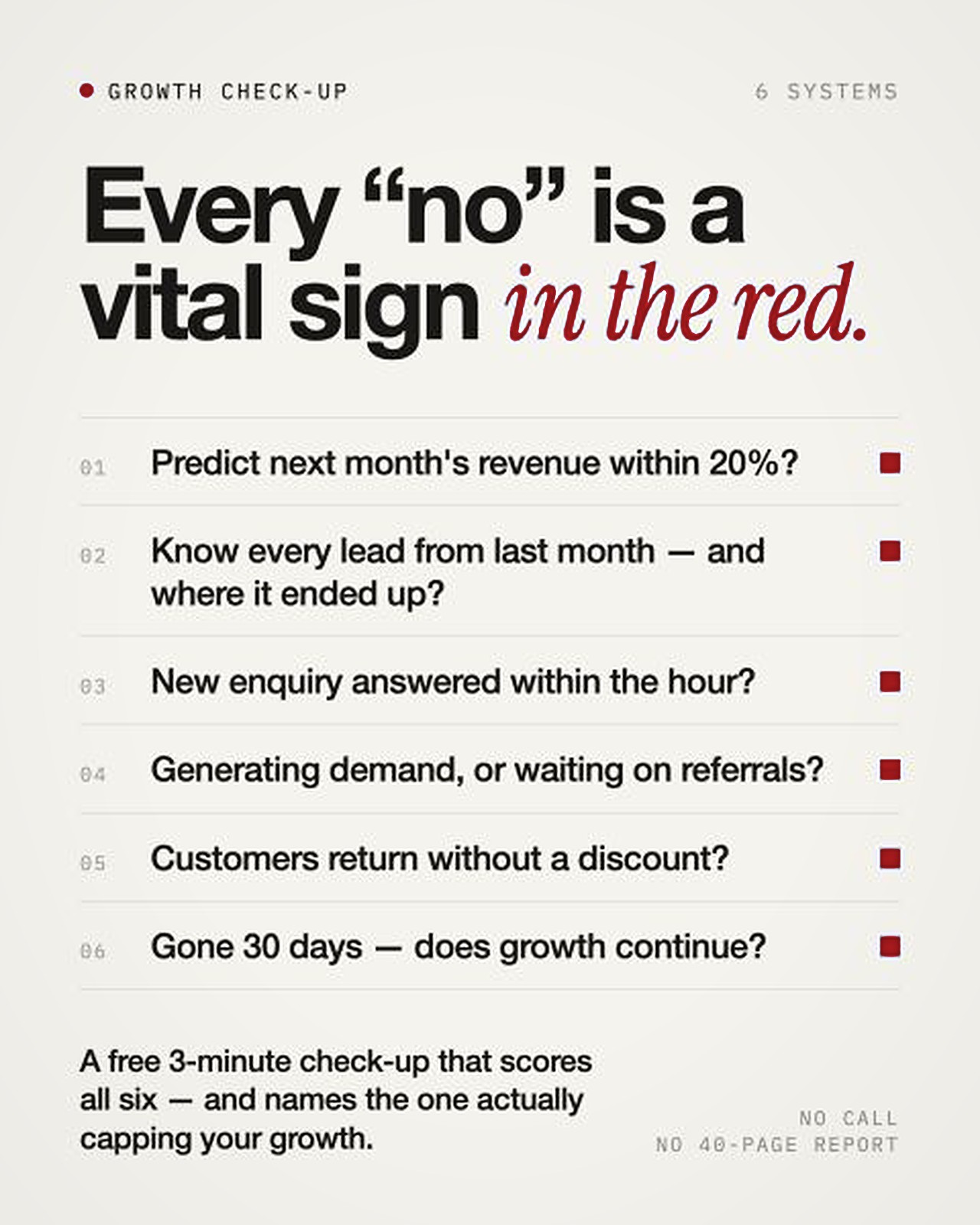
    Can you predict next month's revenue within 20%? Do you know how many leads you got last month — and where each one ended up? Does a new enquiry get a response within an hour, or whenever someone remembers? Are you generating demand, or waiting for referrals? Do customers come back without a discount? If you disappeared for 30 days, would growth continue?

    Every "no" is a vital sign in the red. Most businesses don't have one problem — they have one problem that's loudest, and several quieter ones sitting underneath it that never get addressed because the loud one keeps stealing all the attention.

    Revenue Predictability Is the First Signal

    If next month's revenue is a guess rather than a forecast, the business is being run reactively rather than systematically. This usually isn't a sales problem — it's a visibility problem, where deals, pipeline stages, and close probabilities live in someone's head instead of a system anyone can look at and trust. A growth partner's first job is often just making revenue visible before trying to grow it, which ties closely into how we approach B2B client engagement solutions more broadly — visibility into the relationship is what makes the revenue forecast trustworthy in the first place.

    Knowing Where Every Lead Actually Went

    Most businesses can say roughly how many leads came in last month. Far fewer can say where each one ended up — closed, lost, gone cold, still sitting untouched. That gap is where real revenue quietly disappears. Fixing it isn't about generating more leads through a lead generation strategy alone; it's about building a system that tracks every lead through to an actual outcome, which usually surfaces more recoverable revenue than any new campaign would.

    Response Speed Decides More Deals Than People Realise

    A new enquiry answered within the hour and one answered "whenever someone remembers" are, from the customer's side, two completely different companies. Slow response time doesn't just lose the deal in front of you — it trains prospects to expect mediocrity, which quietly erodes referral quality and word-of-mouth over time. This is one of the fastest, cheapest fixes a growth partner puts in place, because it requires process, not budget.

    Generating Demand vs. Waiting on Referrals

    Referrals feel like a compliment, but relying on them as a strategy is really just outsourcing growth to chance. A business that's actively generating demand — through content, outbound, or paid channels working together — controls its own growth rate. A business waiting on referrals is at the mercy of how many happy clients happen to mention you this month.

    Discount-Free Retention Is a Trust Signal

    If customers only come back when there's a discount attached, that's not loyalty — it's price sensitivity dressed up as retention. Genuine retention, where customers return because of the value and relationship rather than the deal, is one of the clearest signs a business has actually built something durable rather than something that only works while it's on sale.

    The Founder-Dependency Test

    The sixth question is often the hardest to answer honestly: if you disappeared for 30 days, would growth continue? For most founder-led businesses, the answer is no — not because the founder isn't good at their job, but because the business has never been asked to run without them. According to Harvard Business Review's research on founder-led companies, founder involvement can be a genuine advantage early on, but the same dependency that fuels early growth often becomes the ceiling that caps it later, unless the business is deliberately built to run without the founder in every decision.

    Why This Needs a Partner, Not Just More Effort

    None of these six problems get solved by working harder at whichever one feels loudest this week. They get solved by diagnosing all six honestly, then fixing them in the right order — which is precisely what a business growth partner in Pune is built to do, rather than treating growth as six unrelated fire drills.

    As a growth consulting firm based in Baner, Pune, Grimbell built a free 3-minute check-up that scores all six of these signals properly and tells you which one is actually capping your growth — not the one that's loudest. No call required to see your results. No 40-page report. Just a straight diagnosis.

    Ready to find out which of these six is actually holding your business back?

    Talk to Grimbell about becoming your growth partner in Pune.

    FAQs

    What does a business growth partner actually do?
    A growth partner diagnoses the specific bottlenecks holding a business back — revenue visibility, lead tracking, response speed, demand generation, retention, and founder-dependency — and fixes them in priority order, rather than applying generic marketing tactics.

    How is a growth partner different from a marketing agency?
    A marketing agency typically focuses on one channel, like ads or SEO. A growth partner looks at the whole system — sales, retention, and operations included — since growth is rarely capped by marketing alone.

    How do I know which of the six signs is actually my biggest problem?
    Most businesses assume it's whichever issue feels loudest that week, which is often not the real bottleneck. A proper diagnostic, rather than a guess, is the only reliable way to identify it.

    Is this relevant for a business outside Pune?
    The framework applies to any B2B business, though Grimbell works in person and remotely with businesses based in and around Pune specifically, given its base in Baner.

    How does Grimbell's free check-up work?
    It's a 3-minute assessment that scores all six growth signals and identifies which one is actually capping growth — no sales call required and no lengthy report, just a direct diagnosis.

  • Revenue Optimisation Program for Startups: A Practical Playbook

    Revenue Optimisation Service for Startups: A Practical Playbook

    Most startups treat revenue growth and revenue optimisation as the same thing. They aren't. Growth is about adding more customers. Optimisation is about extracting more value, more efficiently, from the customers and pipeline you already have — and for early-stage companies burning through runway, optimisation often moves the needle faster than growth ever does.

    At Grimbell, we run structured revenue optimisation services for startups across India, and the pattern is consistent: founders chase new leads while leaving real money sitting inside pricing, churn, and sales inefficiency. Here's the playbook we use to fix that.

    Audit Pricing Before Anything Else

    Pricing is the single fastest lever in any revenue optimisation service, because a price change affects every future deal immediately, with no new customers required. Most early-stage startups price based on what a competitor charges or what a founder guessed felt reasonable at launch, then never revisit it. A proper pricing audit looks at willingness to pay across different customer segments, checks whether the pricing model itself (per-seat, usage-based, flat fee) actually matches how customers derive value, and tests whether a simple tiering change unlocks revenue that's currently being left on the table by customers who would happily pay more for a higher tier that doesn't yet exist.

    Treat Churn as a Revenue Leak, Not a Support Issue

    Churn is usually filed under "customer success" and treated as a retention problem. In a revenue optimisation service, it's treated as what it actually is: a direct, measurable leak in monthly recurring revenue. The fix starts with segmenting churn by cause — pricing dissatisfaction, poor onboarding, missing features, or simply a bad-fit customer who should never have been sold to in the first place. Startups that treat all churn as one undifferentiated number usually end up solving the wrong problem, spending on features when the real leak was a broken onboarding flow, or vice versa.

    Fix the Sales Funnel Before Adding More Leads to It

    Pouring more leads into a leaky funnel just produces more wasted leads. Before increasing spend on lead generation, a revenue optimisation service looks hard at conversion rate at each stage — demo booked to demo attended, demo to proposal, proposal to close — and finds where the biggest drop-off actually sits. This is closely tied to how we approach B2B client engagement solutions, because a large share of funnel leakage in B2B specifically comes from weak engagement between the demo and the close, not from lead quality itself. Fixing that stage alone often recovers more revenue than any new acquisition channel would.

    Re-Examine Expansion Revenue From Existing Customers

    New customer acquisition gets most of the attention, but expansion revenue — upsells, cross-sells, and upgrades from customers already paying you — is usually cheaper to capture and faster to close. A revenue optimisation service maps which existing customers are under-using the product relative to their usage patterns, and builds a structured upsell motion around that data instead of leaving expansion to chance or to whichever account happens to ask for more seats.

    Align Sales Compensation With What You Actually Want Optimised

    A subtle but common problem: sales teams are often compensated purely on new logo count, which quietly discourages reps from spending time on expansion revenue or from pushing back on discount-heavy deals that hurt margin. If a startup wants a genuine revenue optimisation outcome rather than just top-line growth, compensation structure needs to reflect that — rewarding deal quality and expansion alongside new acquisition, not instead of it.

    Where Lead Generation Still Fits In

    None of this means new lead generation stops mattering — a revenue optimisation service isn't a replacement for a proper lead generation strategy, it's what makes that lead generation spend actually convert once the leads arrive. Startups that run both in parallel — a tightened funnel and pricing model, alongside consistent inbound and outbound lead generation — see the two reinforce each other rather than compete for budget.

    According to McKinsey's research on B2B growth, companies that grow revenue sustainably tend to focus disproportionately on pricing discipline and customer retention rather than acquisition volume alone — which lines up closely with what we see running these services directly with startups on the ground.

    Building a Revenue Optimisation Service With Grimbell

    As a B2B growth consulting firm based in Baner, Pune, Grimbell runs revenue optimisation services for startups that are past the earliest launch phase and starting to feel real pressure on runway and margin. We audit pricing, map churn causes, tighten the sales funnel, and build expansion revenue systems — as one connected service rather than isolated fixes.

    Ready to find out how much revenue is currently sitting untapped in your existing pipeline and customer base?

    Talk to Grimbell about building a revenue optimisation service for your startup.

    FAQs

    What is a revenue optimisation service?
    It's a structured process that improves how much revenue a company extracts from its existing pricing, pipeline, and customer base — covering pricing strategy, churn reduction, sales funnel efficiency, and expansion revenue — rather than focusing purely on acquiring new customers.

    How is revenue optimisation different from revenue growth?
    Revenue growth typically means adding more customers or top-line volume. Revenue optimisation focuses on extracting more value and efficiency from revenue sources that already exist, which is often faster and cheaper for early-stage companies.

    When should a startup start a revenue optimisation service?
    Most startups benefit from this once they have a repeatable sales motion and paying customers, typically after initial product-market fit, when inefficiencies in pricing and churn start to meaningfully affect runway.

    Does revenue optimisation replace the need for lead generation?
    No. It works alongside lead generation rather than replacing it — optimisation ensures the leads a startup already generates convert and retain better, which makes lead generation spend more effective rather than unnecessary.

    How does Grimbell run revenue optimisation services for startups?
    Grimbell audits pricing, segments churn by cause, tightens the sales funnel stage by stage, and builds expansion revenue systems for early-stage B2B companies across India, run as a single connected service from its base in Baner, Pune.