

Blog

  • Client Acquisition Strategy for B2B: A Practical Growth Framework

    Client Acquisition Strategy for B2B: A Practical Growth Framework

    Most B2B companies don't have a client acquisition problem — they have a client acquisition strategy problem. Leads trickle in from referrals, a few come through LinkedIn, someone forwards a cold email that worked once. But there's no system behind any of it, which means growth stalls the moment the founder stops personally hustling for every deal.

    At Grimbell, we work with growth-stage B2B firms across India to replace that ad-hoc hustle with a repeatable client acquisition strategy — one that keeps producing qualified leads whether or not the founder is in the room. This is closely tied to how we approach lead generation for B2B companies more broadly, but acquisition strategy specifically is about the system that turns interest into signed clients, not just the volume of leads coming in. Here's the framework we use.

    Start With a Sharp Ideal Client Profile

    Before any acquisition channel works, you need real clarity on who you're acquiring. Vague targeting, like "small and mid-sized businesses," produces vague pipelines and wastes outbound effort on companies that were never going to convert. A sharp ICP goes beyond industry and company size and gets specific about the trigger event that makes a company ready to buy — a recent funding round, a leadership change, an approaching compliance deadline — along with who inside that company feels the pain first versus who actually signs off on the budget. Every acquisition tactic downstream, whether it's content, outbound, or paid media, gets noticeably sharper once this groundwork is done properly.

    Build an Outbound Engine, Not a One-Off Campaign

    Cold outreach fails most often when it's treated as a campaign with a defined start and end date rather than an ongoing system. It works when it's run as an engine: a steady cadence of researched, personalized touches across email and LinkedIn, running continuously, and refined weekly based on actual reply rates rather than gut feeling. The B2B companies that consistently win at client acquisition tend to run several outbound tracks in parallel — one for genuinely cold prospects, one for warm re-engagement of people who went quiet mid-conversation, and one built around referral-based introductions — rather than depending on a single list that eventually gets exhausted.

    Let Content Do the Pre-Selling

    By the time a B2B buyer actually talks to a salesperson, they've usually already formed an opinion about whether your company is worth their time. Case studies, direct comparison pages, and specific how-to content do far more of the pre-selling work than generic thought leadership ever does, because they answer the exact questions a buyer is quietly researching before they'll agree to a call. This is one of the reasons our work on B2B client engagement solutions treats content and acquisition as the same conversation rather than separate workstreams — the content that engages an existing client is often the same content that convinces a new one to say yes.

    Fix the Handoff Between Marketing and Sales

    A large share of leads that get written off as "lost to a competitor" are actually lost to a broken internal handoff. Marketing generates genuine interest, sales takes three days too long to follow up, and by then the buyer has moved on or lost urgency. A clear service-level agreement — who follows up, within what timeframe, with what specific message — fixes more pipeline leakage than almost any new acquisition channel would. According to HubSpot's research on B2B lead response times, companies that respond to leads within an hour are far more likely to have a meaningful conversation with a decision maker than those that wait even a few hours longer, which underlines just how much revenue quietly disappears in the handoff gap alone.

    Track Acquisition Cost by Channel, Not Just in Aggregate

    Knowing your blended customer acquisition cost tells you very little on its own. Knowing that outbound LinkedIn costs three times what referrals cost, but converts twice as fast, tells you exactly where to double down and where to pull back. This level of channel-specific tracking is where most growing B2B firms fall short, largely because it requires tagging and reviewing data weekly rather than glancing at a dashboard once a quarter — but it's usually the fastest lever available once it's in place.

    Building This as a Growth Partner in Pune

    As a B2B growth consulting firm based in Baner, Pune, Grimbell builds exactly this kind of client acquisition system for founders who are done relying on referrals alone to fill their pipeline. We handle the ICP definition, the outbound engine, the content strategy, and the sales-marketing alignment together, as one system, so acquisition keeps running steadily even during your busiest weeks.

    Ready to build a client acquisition strategy that doesn't depend on you personally chasing every lead?

    Talk to Grimbell about building a client acquisition system for B2B.

    FAQs

    What is a client acquisition strategy in B2B?
    It's the repeatable system a company uses to identify, reach, and convert its ideal clients — combining a defined target profile, consistent outbound activity, supporting content, and a clear process for moving a lead from first contact to signed deal.

    How is client acquisition different from lead generation?
    Lead generation focuses on generating interest and contacts. Client acquisition strategy covers the full system, including how those leads are qualified, nurtured, and actually converted into paying clients.

    How long does it take to see results from a new client acquisition strategy?
    Most B2B companies start seeing measurable pipeline movement within 8 to 12 weeks, though timelines vary by industry, deal size, and how warm the starting audience is.

    Do I need a large sales team to run this framework?
    No. The framework is built around systems and cadence rather than headcount, which makes it workable for lean founder-led teams as well as larger sales organizations.

    How does Grimbell help with client acquisition for B2B companies in Pune?
    Grimbell builds the full acquisition system — ICP definition, outbound engine, content, and sales-marketing alignment — tailored to B2B companies in Pune and across India, so growth doesn't depend entirely on the founder's personal network.
  • AI Business Solutions

    AI Business Solutions

    Every business conversation in India right now seems to circle back to the same topic. AI business solutions are being discussed in boardrooms, WhatsApp groups, startup accelerators, and founder meetups across the country — and the energy around artificial intelligence in business is genuinely unprecedented. What is less real, for many of the businesses investing in AI right now, is the return on that investment. Despite the enthusiasm, a significant number of Indian B2B businesses report that the impact on their actual revenue and operational efficiency has been modest at best — not because the tools are bad, but because they were adopted before the strategy was clear.

    The AI Gold Rush: Why Businesses Are Chasing Every New Tool

    There is a pattern repeating itself across India's business landscape right now that is worth naming directly. A founder sees a competitor using an AI tool. Or they attend a conference where every speaker mentions a different AI platform. The pressure to adopt — to not be left behind — is real and understandable. The result is that many businesses are acquiring AI tools reactively, based on fear of missing out rather than a clear diagnosis of which specific problem the tool is meant to solve.

    A chatbot gets deployed on the website without a clear lead qualification strategy behind it. A content automation tool gets purchased without a content distribution plan. A CRM with AI features gets implemented without the sales process discipline that would allow those features to actually improve conversion rates. Each of these tools works as advertised — but working as advertised is not the same as delivering business outcomes. The gap between those two things is almost always a strategy gap, not a technology gap.

    Technology Without Strategy Creates More Complexity

    There is a common assumption that more tools equal more capability. In practice, for most B2B businesses at the growth stage, more disconnected tools equal more complexity — and more complexity absorbs exactly the kind of founder and team bandwidth that should be going toward revenue-generating activities. When AI tools are adopted without a clear workflow design behind them, the result is often a situation where the team is managing both the old manual process and the new automated one simultaneously, because nobody is fully confident the automated version is reliable.

    This is not an argument against artificial intelligence. It is an argument for sequencing. The businesses that extract genuine value from AI business solutions are the ones that clearly defined their operational bottlenecks and growth objectives before they selected and implemented technology.

    Where AI Business Solutions Deliver Real Value

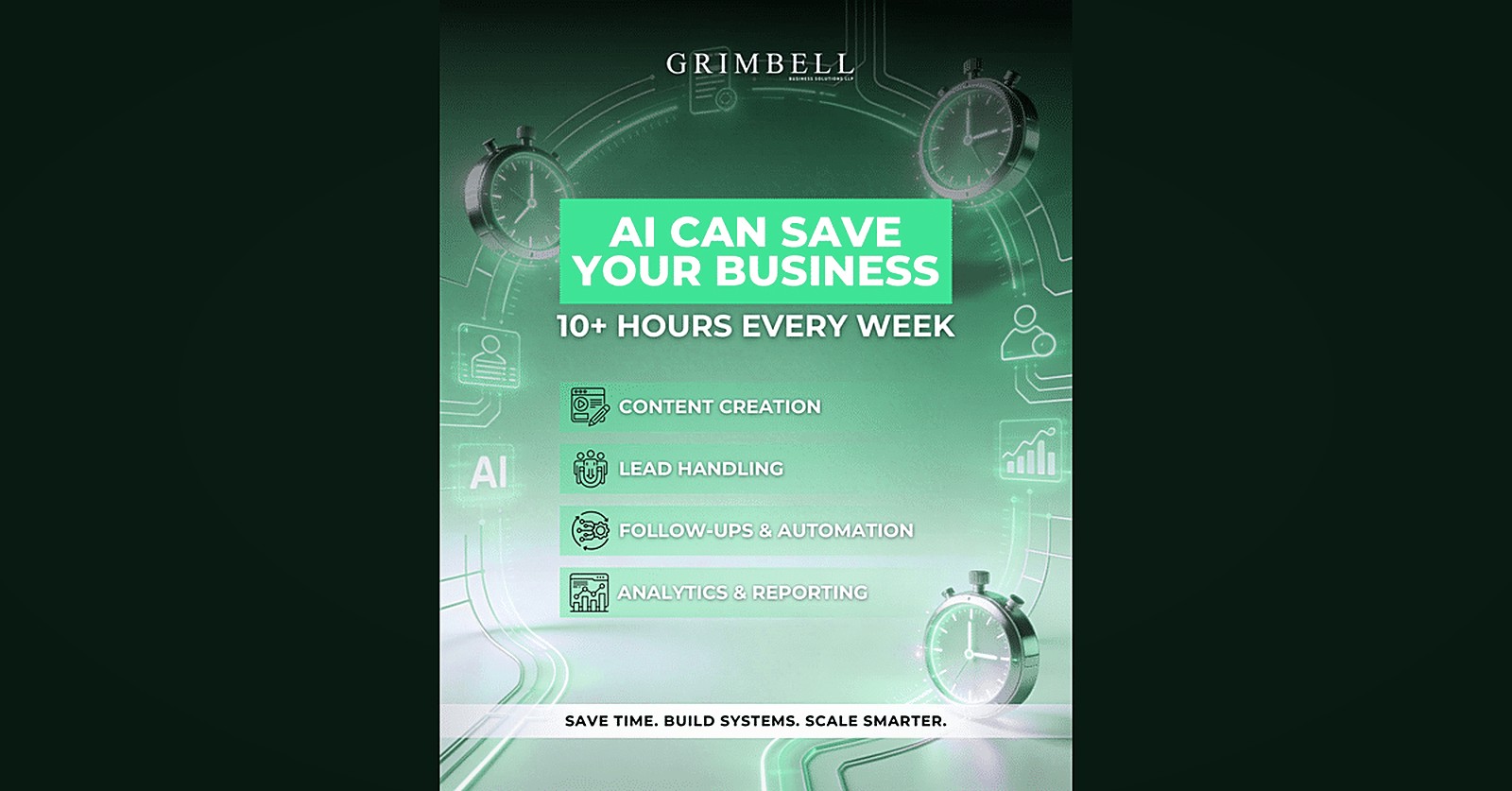
    When AI is implemented with a clear strategy behind it, the results can be genuinely transformative. Marketing workflow automation is one of the highest-impact applications — when a business has a clear content strategy and a defined audience, AI tools can dramatically accelerate content production and distribution. Sales follow-up automation delivers strong ROI when the sales process is already well-defined and the messaging is sharp. Customer engagement systems, reporting and analytics, and internal operations all represent genuine AI value creation opportunities — but in every case, the value created is proportional to the clarity of the strategy surrounding the tool.

    Why Human Expertise Still Drives Business Growth

    AI is extraordinarily good at pattern recognition, content generation, data processing, and task automation. It is not good at understanding the nuances of a specific client relationship, reading a room during a difficult negotiation, or building the kind of trust that sustains long-term business partnerships. The businesses that grow most effectively in an AI-enabled world are not the ones that replace the most human functions with automation. They are the ones that use AI to handle repetitive, lower-judgment tasks so that their people can focus more energy on the high-value, high-judgment work that actually differentiates the business.

    Building AI Around Business Goals

    The right starting point for any AI adoption conversation is not which tools to use. It is what specific operational bottlenecks and revenue constraints need to be addressed, and how success would be measured. Businesses that want AI to generate measurable business outcomes need a structured growth strategy before implementing automation. Grimbell's Revenue Growth Consulting helps organisations identify operational bottlenecks and align technology investments with measurable revenue goals — so that when AI tools are introduced, they are solving real, defined problems.

    Likewise, automation becomes significantly more effective when it supports consistent customer communication. Grimbell's B2B Client Engagement Solutions help businesses create scalable engagement systems that combine intelligent automation with personalised customer experiences — ensuring that efficiency gains from automation do not come at the cost of relationship quality.

    Conclusion

    AI is no longer the competitive advantage. Every business can access the same tools. The real advantage belongs to organisations that build clear systems, align technology with strategy, and empower people to focus on high-value work. Businesses that approach AI with clarity rather than hype will be the ones that grow sustainably in the years ahead.

    For Indian B2B businesses ready to build that clarity and develop the strategic foundation that makes AI adoption genuinely effective, Grimbell Business Solutions is the growth partner designed for exactly that work. Talk to Grimbell about building your AI-ready growth strategy today.

  • Brand Clarity & Sales Growth

    Brand Clarity & Sales Growth

    There is a quiet frustration that sits at the heart of many Indian B2B businesses — one that is rarely spoken about directly but is felt consistently in sales conversations that do not convert, in marketing efforts that generate activity but not revenue, and in leadership teams that are working harder than ever without quite understanding why the results are not keeping pace. The answer, in most of these cases, is not a lack of talent, not a lack of effort, and not a bad product. It is a lack of clarity — and for businesses looking for real sales growth consulting in Baner Pune and across India, this is precisely where the conversation needs to start.

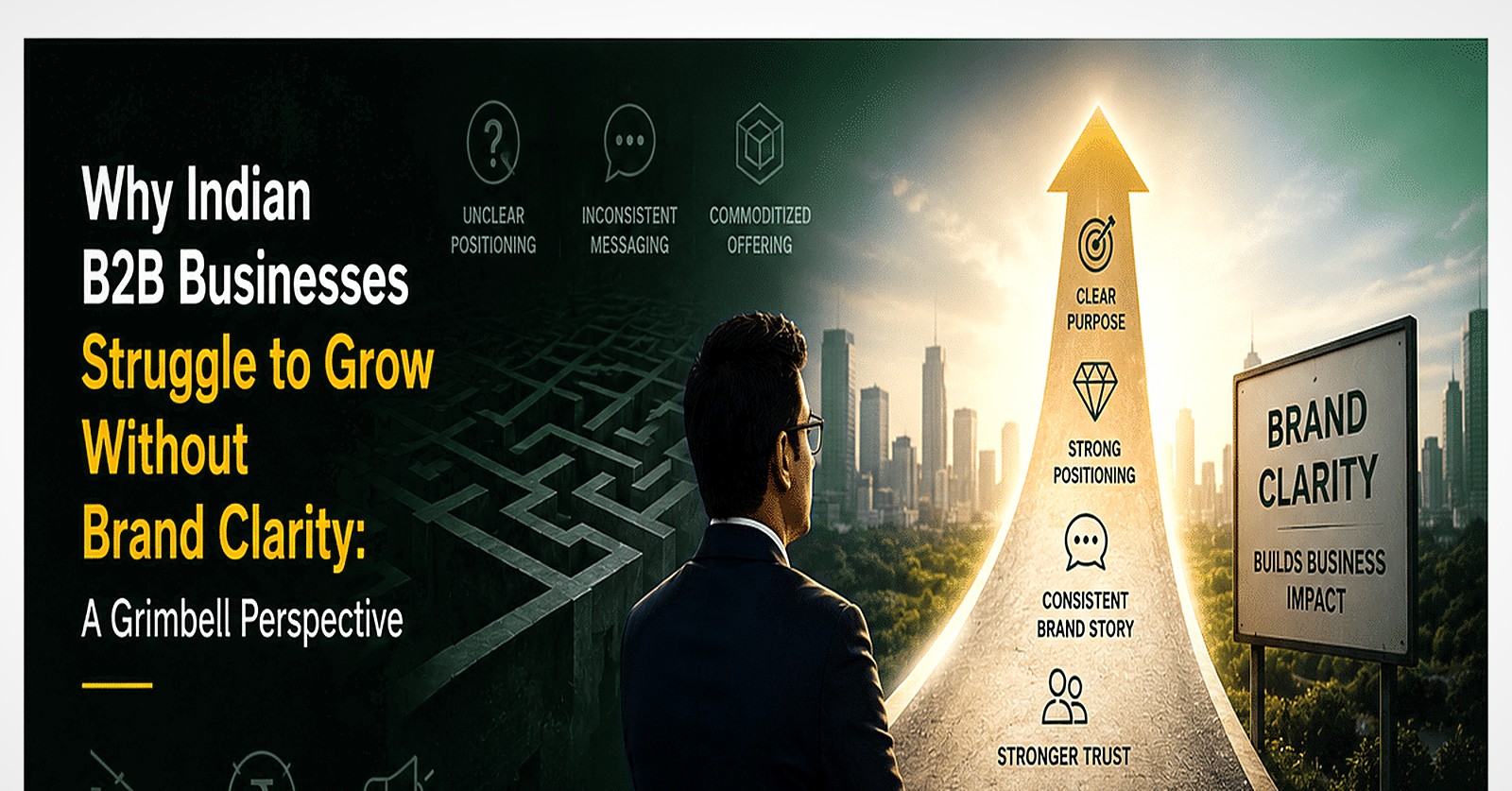
    Most businesses do not struggle because of lack of talent. They struggle because of lack of clarity. This single insight, drawn from Grimbell's work with B2B businesses across India, explains more about why good businesses plateau than almost any other factor. Talent gets you into the room. Clarity is what makes people listen once you are there.

    What Lack of Clarity Actually Looks Like in Practice

    Brand clarity is one of those concepts that sounds abstract until you see what its absence looks like in a real business. Before strong branding, a business does everything — it says yes to every type of client, positions itself as a solution to every problem, and tries to be relevant to the broadest possible audience. The result is that it becomes genuinely relevant to nobody in particular.

    Before strong branding, a business competes on price — because when you cannot articulate clearly why you are different or better, price becomes the only remaining point of comparison. And before strong branding, a business is visible but not memorable — it shows up in searches, gets considered in shortlists, makes it to final meetings, and then loses to a competitor who communicated their value with more precision and confidence.

    What Changes When Clarity Arrives

    After strong branding, a business has a clear message — one that speaks directly to the specific clients it is best positioned to serve, in language those clients actually use to describe their own problems. After strong branding, a business has sharp positioning — it knows exactly where it sits in the market, what it does better than anyone else, and what it is not trying to be. And after strong branding, a business has value-driven confidence — the kind that comes not from arrogance but from genuinely understanding the transformation it delivers for its clients.

    The result is not just visibility — it is credibility. Not just reach — it is trust. If your brand feels scattered, you do not need more content. You need clarity. This is one of the most important realisations a B2B founder can have — and it is the starting point for every engagement Grimbell has with a new client.

    Why Brand Clarity Is a Revenue Growth Issue, Not Just a Marketing Issue

    This is the point where many business owners make a critical mistake. They hear "brand clarity" and think it is a marketing department problem — something to hand off to a designer or a copywriter while the leadership team focuses on the real business of sales and revenue. But brand clarity is fundamentally a revenue issue. When your messaging is unclear, your sales team struggles to articulate value consistently. When your positioning is vague, your marketing spend generates impressions rather than conversations.

    How Grimbell Approaches Brand Clarity as Part of Growth

    At Grimbell Business Solutions, brand clarity is not treated as a standalone project separate from growth strategy. It is treated as a foundational layer that everything else sits on. Before building a lead generation system, before optimising a sales process, before designing a client retention service, the question of whether the business's positioning and messaging are sharp enough to support those efforts has to be answered honestly.

    This is why the Grimbell Booster service starts with a diagnostic phase that covers brand positioning alongside revenue model, sales process, and client acquisition strategy. Not because branding is the only thing that matters, but because in most Indian B2B businesses, unclear positioning is quietly undermining the effectiveness of every other growth effort — and fixing it first makes everything else work significantly better.

    The Practical Steps to Building Brand Clarity

    Building brand clarity does not require a complete rebrand or a months-long strategy process. It requires honest answers to a small number of foundational questions that most businesses have never explicitly addressed. The first question is who exactly your ideal client is. The second question is what specific outcome your business delivers for that client. The third question is why your business is the right choice for that specific client over every available alternative.

    When a business can answer these three questions with precision and consistency, the clarity that results flows naturally into every part of how it shows up in the market. For businesses that have worked through this process with Grimbell, the shift is often described not just as a marketing improvement but as a fundamental change in how the leadership team thinks and talks about their own business. Read more about how this connects to our broader approach in our post on what a business growth partner in Pune can actually do for your company.

    Conclusion

    Brand clarity is not a luxury that businesses pursue after they have achieved a certain level of success. It is a prerequisite for achieving that success in the first place. For Indian B2B businesses that are working hard, delivering good results for their clients, and still struggling to grow at the rate their capability deserves, the missing element is almost always clarity — in positioning, in messaging, and in the confidence that comes from knowing exactly who you serve and why you are the right choice for them.

    Sales strategy, lead generation, and client retention all become dramatically more effective when they are built on a foundation of genuine brand clarity. And for B2B businesses in Pune and across India that are ready to build that foundation, Grimbell Business Solutions is the growth partner designed for exactly that work. Talk to Grimbell about building clarity and scalable growth for your business today.

  • B2B Client Engagement Solutions

    B2B Client Engagement Solutions

    There is a pattern that shows up in almost every B2B business in India that has been operating for more than three or four years. The early clients — the ones won through founder relationships, word of mouth, and sheer hustle — tend to stay. But somewhere along the way, the energy that went into winning and nurturing those early clients gets redirected entirely toward acquiring new ones, and the existing client relationships quietly start to coast. This is where the need for structured B2B client engagement solutions becomes not just useful but genuinely urgent — because coasting client relationships do not stay stable forever. They gradually erode, and the revenue that seemed safe slowly starts to leak.

    What B2B Client Engagement Actually Means

    Client engagement refers to the quality, consistency, and depth of the relationship between a business and its clients — not just at the point of sale, but throughout the entire lifecycle of the relationship. Genuine client engagement means understanding each client's evolving business priorities, proactively sharing relevant insights and opportunities, delivering consistent value that goes beyond the contracted scope, and building the kind of trust that makes a client think of your business first when a new need arises.

    The businesses that do this well do not leave it to chance. They build systems and processes that make consistent, high-quality engagement a structural feature of how the business operates, rather than something that depends on the effort and memory of individual people.

    Why Most Indian B2B Businesses Struggle With Client Engagement

    Most Indian B2B businesses were never designed with client engagement as a deliberate function. They were designed around delivery. Client engagement, to the extent it happened at all, happened informally, driven by the founder's personal relationships. This approach works well at a small scale. But as the business grows and the client base expands to twenty, thirty, or fifty accounts, this personal approach simply cannot scale. Relationships start slipping through the cracks — not because anyone is being negligent, but because the system was never designed to handle that volume.

    The result is a common and painful pattern: strong delivery, weak retention. Clients leave not because the work was bad, but because they felt like a number rather than a priority. Because a competitor reached out at exactly the right moment and offered something that felt more attentive, more engaged.

    The Three Pillars of Effective B2B Client Engagement

    The first pillar is structured touchpoint cadence. Every client relationship should have a defined rhythm of proactive contact that happens regardless of whether there is an immediate business need driving it. A well-designed cadence includes formal reviews, informal check-ins, and value-add moments where relevant insights are shared proactively.

    The second pillar is client intelligence. Effective engagement requires knowing what is happening in each client's business — their current priorities, their challenges, their growth plans. This intelligence should be captured systematically and made available to everyone who interacts with the client.

    The third pillar is expansion mindset. The most commercially successful client engagement services treat every existing client relationship as an opportunity to grow, not just retain — regularly identifying where the business could be delivering additional value and having structured processes for acting on those opportunities.

    How Grimbell's Engagement Engine Builds This System

    At Grimbell Business Solutions, structured client engagement is delivered through the Engagement Engine service — designed specifically for Indian B2B businesses that want to move from informal, relationship-dependent client management to a systematic, scalable approach that grows revenue from existing clients while building loyalty that generates referrals consistently.

    The Engagement Engine starts by mapping the current state of every client relationship — identifying which accounts are genuinely engaged, which are at risk of drifting, and which are underutilised relative to the value the business could be delivering. From there, a structured engagement framework is built covering touchpoint cadence, client intelligence systems, and expansion opportunity identification.

    What This Means for Revenue

    The commercial impact of moving from informal to structured client engagement is typically significant and relatively fast to materialise. Retention improves because clients who feel genuinely engaged are far less likely to evaluate alternatives. Expansion revenue grows because structured processes surface opportunities that informal relationships miss. And referral rates increase because clients who feel well looked after tend to talk about it.

    For most Indian B2B businesses, existing clients represent the highest-return growth opportunity available — higher than new client acquisition, which requires significantly more time, cost, and effort to convert. A structured approach to client engagement is not just a relationship management tool. It is a revenue growth strategy that compounds over time, becoming more valuable as the client base grows and as the depth of each relationship deepens.

    Conclusion

    B2B client engagement solutions are not a luxury for businesses that have already figured everything else out. They are a foundational growth lever that most Indian B2B businesses are leaving almost entirely untapped. Growth does not happen by chance. It happens by design. And for Indian B2B businesses ready to build a client engagement system that scales, Grimbell Business Solutions is the partner built for exactly that work.

    Talk to Grimbell about building your client engagement system today.

  • Lead Generation Agency in India

    Lead Generation Agency in India

    For most B2B companies in India, the single biggest constraint on growth is not the quality of their product or service — it is the consistent, predictable flow of qualified leads. Founders and sales teams spend enormous energy chasing referrals, attending networking events, and sending cold outreach, only to find that the pipeline remains unpredictable month after month. This is precisely the gap that a specialised lead generation agency in India is built to close.

    Lead generation, done properly, is not about generating as many contacts as possible. It is about building a systematic process that consistently identifies, reaches, and engages the right prospects — the ones who actually have the budget, the need, and the authority to buy what you sell. For B2B companies competing in increasingly crowded markets, this distinction between volume and quality is the difference between a growing pipeline and a wasted marketing budget.

    What a Lead Generation Agency Actually Does

    There is a common misconception that lead generation simply means buying a list of contacts and sending out a mass email campaign. This approach rarely works for B2B sales in India, where decision-makers are inundated with generic outreach and have become highly skilled at ignoring it.

    A genuine lead generation agency starts with a much more fundamental question: who exactly is your ideal client, and what specific combination of company size, industry, role, and pain point makes them a strong fit for what you sell. This ideal client profile becomes the foundation for every subsequent activity.

    From there, a proper lead generation process typically combines multiple channels working together — targeted outbound outreach on platforms like LinkedIn, content marketing that attracts inbound interest, search engine optimisation that captures buyers actively researching solutions, and structured follow-up sequences that nurture prospects who are not yet ready to buy.

    Why Indian B2B Companies Are Investing in Lead Generation Expertise

    India's B2B economy has changed dramatically over the past several years. A new generation of SaaS companies, professional services firms, manufacturing businesses, and logistics providers are all competing for the attention of a relatively limited pool of enterprise and mid-market buyers.

    In this environment, businesses that rely solely on founder networks and word-of-mouth referrals find that those channels simply cannot sustain the growth targets they have set for themselves. Bridging that gap requires a structured, repeatable lead generation engine, which is exactly what a specialised agency brings.

    The Engagement Engine Approach to Lead Generation

    At Grimbell Business Solutions, lead generation and client acquisition for B2B companies is delivered through a structured service called Engagement Engine — built specifically to give Indian B2B businesses a predictable, scalable system for finding and converting the right clients.

    The Engagement Engine process begins with a precise definition of the ideal client profile — not a broad, generic description, but a specific, data-informed picture of the companies and decision-makers most likely to convert and become long-term clients.

    Critically, the service does not stop at generating initial interest. Engagement Engine builds structured nurture and qualification processes that move prospects through the pipeline systematically, ensuring that the leads handed over to a sales team are genuinely ready for a meaningful conversation.

    How to Evaluate a Lead Generation Agency in India

    The lead generation services market in India is crowded, and not every agency that claims expertise in this area can actually deliver consistent, qualified pipeline. Ask how they define a qualified lead, how they personalise messaging, and how they measure and report success — transparency in reporting is a strong signal of a results-oriented partner.

    Conclusion

    A reliable lead generation agency in India does far more than fill a pipeline with names and email addresses. It builds a precise, repeatable system that consistently identifies and engages the right prospects, qualifies them thoughtfully, and hands a sales team conversations that are genuinely worth having.

    For B2B companies ready to move beyond unpredictable referral-based growth, Grimbell Business Solutions' Engagement Engine service offers exactly this kind of structured, accountable approach to client acquisition. Talk to Grimbell about building your B2B pipeline today.

  • Revenue Growth Consulting

    Revenue Growth Consulting

    Most Indian businesses we work with at Grimbell have a growth problem that isn't really about traffic, talent, or even product quality — it's about having no system. Revenue happens, but it happens unpredictably, dependent on a handful of key relationships, a founder's personal network, or whichever salesperson is having a good month. The businesses that successfully scale past this early stage are the ones that build a repeatable revenue growth engine, not just a sales target written on a whiteboard. This is the core problem that revenue growth consulting exists to solve.

    Over the past several years working with startups and SMEs across Pune and the wider Indian market, we've noticed the same pattern again and again. A business hits an early ceiling — somewhere between 50 lakhs and a few crores in annual revenue — and growth simply stops compounding. Marketing spend goes up, but new customer acquisition doesn't follow proportionally. Sales calls get booked, but conversion rates stay flat. The founder works longer hours, but the business doesn't scale faster. This is exactly the inflection point where structured revenue growth consulting makes the biggest difference.

    What revenue growth consulting actually involves

    Revenue growth consulting isn't about motivational sales training, a one-time strategy deck, or a generic "10 tips to grow your business" framework. At Grimbell, our approach centres on three core pillars — identifying exactly where revenue is leaking out of your funnel, building predictable and diversified acquisition channels, and creating internal systems that let your team execute consistently without the founder needing to be in every single meeting or sales call.

    The diagnostic phase is where most of the real insight happens. We map your entire revenue journey — from the very first touchpoint a prospect has with your brand, through every stage of qualification, negotiation, and close. In nearly every engagement, we find at least two or three points where qualified leads are quietly falling away, often because of process gaps that nobody noticed because everyone was too busy executing day to day.

    "Growth isn't a department — it's the output of every function working toward the same number." — Grimbell Booster Framework

    Why most growth plans fail in the Indian market

    Generic growth playbooks built for Western SaaS companies or Silicon Valley startups rarely translate directly to Indian B2B and SME businesses. Buying cycles in India are typically longer, decision-makers are often more risk-averse, and trust is built through relationships and word-of-mouth as much as through data and case studies. A revenue growth consultant who genuinely understands the Pune and broader Indian business landscape builds strategies around these realities, not against them.

    We've seen businesses burn significant marketing budgets trying to replicate growth tactics that work brilliantly for a US-based product company but completely miss how an Indian distributor, manufacturer, or service business actually makes a purchasing decision. Multiple stakeholders are usually involved, price sensitivity plays out differently across regions, and the sales cycle often includes an in-person or relationship-driven component that pure digital funnels tend to ignore. Effective revenue growth consulting accounts for all of this from day one.

    How Grimbell Booster works

    Grimbell Booster is our dedicated revenue optimization service built specifically for startups and growth-stage businesses across India. Every engagement starts with a full audit of your current revenue funnel — where leads actually come from, where they drop off, what messaging resonates versus what falls flat, and what's genuinely converting versus what just looks good on a dashboard.

    From that audit, we build a prioritised action plan covering pricing strategy, sales process redesign, and channel diversification, so your growth no longer depends on any single lead source or any single person on your team. This often means restructuring how leads are qualified, introducing clearer follow-up sequences, and in many cases, helping businesses identify an entirely new acquisition channel they hadn't previously considered.

    A typical Grimbell Booster engagement runs across several weeks of focused work. We don't believe in handing over a 40-page strategy document and disappearing — implementation support is built into the service because strategy without execution rarely moves the needle. Our team works alongside yours, often embedded directly into weekly sales and marketing reviews, to make sure the changes we recommend are actually happening on the ground.

    Signs your business needs a revenue growth partner

    There are a few clear signals that indicate a business would benefit significantly from structured revenue growth consulting rather than continuing to try and fix things internally. If your revenue is concentrated in just two or three clients, you have a concentration risk that one lost contract could seriously damage. If your entire sales process lives in one person's head — with no documented playbook, no CRM hygiene, and no way for a new hire to ramp up quickly — your growth is capped by that one person's bandwidth.

    Another common signal is when a business has plateaued despite spending considerably more on marketing than it did a year or two ago. This usually points to a leaky funnel rather than a traffic problem — more visitors and leads are coming in, but the conversion mechanics underneath haven't improved to match. These are exactly the kind of structural gaps that a revenue growth consulting partner is trained to spot quickly, because an outside perspective sees patterns that are often invisible from inside daily operations.

    The role of data in modern revenue growth

    One thing that's changed significantly over the past few years is how much visibility businesses can have into their own revenue funnel, if they choose to use the data available to them. Most Indian SMEs are sitting on a surprising amount of usable data inside their CRM, WhatsApp Business records, and ad platform dashboards — but very few are actually analysing it systematically to make decisions.

    Part of what we do at Grimbell is help businesses build a simple, sustainable habit of reviewing this data weekly — not vanity metrics like impressions or followers, but the numbers that actually predict revenue: lead-to-meeting conversion rate, meeting-to-proposal rate, proposal-to-close rate, and average deal size. Tracking these consistently turns growth from a guessing game into something far more predictable, and gives a business growth partner the visibility needed to recommend the right next move.

    Getting started with a free consultation

    Every Grimbell Booster engagement starts with a free initial consultation, where we map your current revenue model together and identify the two or three highest-leverage changes you could realistically make this quarter. There's no pressure and no generic sales pitch — just an honest look at where your revenue engine currently stands and what's genuinely possible from here.

    Based in Baner, Pune, our team works with businesses across Maharashtra and pan-India, both in person and remotely, depending on what works best for your team. If you're ready to move from unpredictable, relationship-dependent revenue to a system that compounds quarter after quarter, reach out to start the conversation.